
How to Build an MVP App for Your Startup in 2026

Quick Answer: An MVP (Minimum Viable Product) app is the leanest version of your app that delivers real value to early users. In 2026, you can build one in 8–16 weeks for $8,000–$35,000 depending on complexity, team location, and tech stack. This guide walks you through every step. |
Introduction: The Startup Graveyard Is Full of Over-Built Apps
Most startups don’t fail because their technology was bad. They fail because they spent 12 months and $150,000 building the wrong thing. In 2026, with AI-assisted development and lean tooling, there is zero excuse for skipping the MVP phase.
An MVP — Minimum Viable Product — is your way of testing real demand before betting everything on a full product. Companies like Airbnb, Dropbox, Uber, and Instagram all launched as bare-bones MVPs. Airbnb started with a simple website and air mattresses. Dropbox launched with a demo video before writing a single line of backend code.
Whether you’re building a SaaS platform, a marketplace, a fintech app, or a niche utility, this guide covers every step you need — with real timelines, cost data for 2026, and strategic advice from Mr Mobile App Developer, a freelance developer with 22+ years and 125+ projects across 24 countries.
1. What Is an MVP App? (Definition + Real Examples)
An MVP app is the version of your product with just enough features to attract early adopters, validate your core hypothesis, and collect actionable feedback — nothing more, nothing less.
The three pillars of a true MVP are:
- Minimum — strip out everything that is not essential to the core promise
- Viable — it must actually work and provide real value
- Product — it is a shippable, testable thing, not a prototype or mockup
Famous MVP Examples
Company | MVP Approach |
Airbnb | A simple webpage listing one apartment in San Francisco |
Dropbox | A 3-minute explainer video — no product existed yet |
Uber | SMS-based car booking in San Francisco only |
Photo sharing + filters only; no DMs, no Stories | |
Zappos | Manually bought shoes and shipped them; no inventory system |
2. Why Build an MVP Before a Full Product?
Building an MVP in 2026 is not just smart — it’s the only rational strategy for any resource-constrained startup. Here’s why:
- Validate demand before you over-invest in engineering
- Get real user feedback that shapes the right product roadmap
- Attract investors and early customers with a live proof of concept
- Reduce time-to-market from 12–18 months to 8–16 weeks
- Preserve runway by spending $15K–$35K instead of $150K+
- Identify the right tech stack and architecture early
- Step 1 — Validate Your App Idea Before Writing Code
Validation is the most under-rated and most skipped step in startup development. Before any wireframe is drawn or any developer is hired, you must answer one question: Do real people have this problem badly enough to pay for a solution?
How to Validate in 2026
- Customer Discovery Interviews: Talk to 20–30 potential users. Ask about the pain, not the solution. Don’t pitch, just listen.
- Landing Page Test: Build a one-page site explaining the app (no app needed yet). Run $50–$200 in Google or Meta ads. Measure sign-ups.
- Competitor Analysis: If competitors exist, it proves demand. Study their 1-star reviews on the App Store — that’s your product roadmap.
- Smoke Test / Fake Door Test: Add a “Download Now” CTA. If people click, desire is real. Zapier famously validated this way.
- Reddit & Community Research: Search subreddits and Facebook groups in your niche. Are people asking for exactly what you want to build?
Pro Tip: Mr Mobile App Developer offers a structured app idea validation consultation for startups before any development begins. See the MVPs & Bespoke Solutions service or read the companion guide — How to Validate an App Idea Before Development.
4. Step 2 — Define Core Features Using the MoSCoW Method
Once you’ve validated demand, the next temptation is to build everything. Resist it. Your MVP should solve one core problem brilliantly — not ten problems adequately.
Use the MoSCoW method to prioritize ruthlessly:
Priority | Description | Target Version |
Must Have | Core features without which the app has no value | MVP Scope |
Should Have | Important but not critical for launch | Version 1.1 |
Could Have | Nice-to-have enhancements | Version 2.0 |
Won’t Have | Out of scope for now — park these ideas | Future |
MVP Feature Checklist Example: On-Demand Service App
- Must Have: User registration/login, service request flow, payment gateway, provider matching
- Should Have: Push notifications, ratings & reviews, basic analytics dashboard
- Could Have: Loyalty points, multi-language support, in-app chat
- Won’t Have (MVP): AI scheduling, AR features, social sharing
See a live example of a well-scoped MVP: Home Service Management System built by Mr Mobile App Developer — a lean on-demand platform with core booking, matching, and payment built first.
5. Step 3 — Choose the Right Tech Stack for Your MVP
Your tech stack choice affects your budget, launch speed, and scalability. In 2026, the best stacks for MVP development lean toward cross-platform frameworks and serverless backends that minimize cost and maximize iteration speed.
Recommended Tech Stacks by App Type
App Type | Frontend | Backend | MVP Timeline |
Consumer Mobile App | Flutter or React Native | Firebase / Supabase | 6–12 weeks |
SaaS Web App | React.js / Next.js | Node.js + PostgreSQL | 8–14 weeks |
Marketplace / Platform | React Native + Web | Node.js + AWS / GCP | 10–16 weeks |
Fintech / Payments | Flutter | Node.js + Stripe + PCI DB | 12–18 weeks |
AI-Powered App | React Native | FastAPI + OpenAI / Gemini | 10–16 weeks |
Why Flutter and React Native Dominate in 2026
- Single codebase for iOS and Android — cuts dev cost by 40–60%
- Near-native performance with mature ecosystems
- Huge talent pool and community support
- Excellent tooling for rapid iteration and hot reload
Mr Mobile App Developer specializes in Flutter, React Native, and full-stack web MVPs. View the portfolio and case studies for real examples.
6. Step 4 — Wireframe & Design the UX
In an MVP, UX design must be purposeful and lean. You’re not designing to impress — you’re designing to convert and test. Every screen should serve a clear function.
Wireframing Process (2–3 Weeks)
- User Flow Mapping: Map every screen the user will touch from onboarding to core action to exit. Use FigJam or Miro.
- Low-Fidelity Wireframes: Sketch box-level layouts — no colours, no fonts. Validate the flow logic.
- High-Fidelity Mockups: Add brand colours, typography, and component styling using Figma.
- Clickable Prototype: Link screens in Figma or ProtoPie. Test with 5–10 real users before writing code.
- Design System: Create a minimal component library (buttons, inputs, cards, typography) for dev handoff.
7. Step 5 — Build & Launch Your MVP
With validated idea, scoped features, chosen stack, and finalized designs, you’re ready to build. Here’s how a professional MVP development sprint looks over 10–14 weeks:
Sprint | Phase | Key Deliverables |
Week 1–2 | Project Setup | Repo, CI/CD pipeline, architecture, backend scaffolding, DB schema |
Week 3–4 | Core Backend | Auth, user management, core business logic APIs |
Week 5–7 | Frontend Build | Screens, navigation, API integration, state management |
Week 8–9 | Integrations | Payments, push notifications, maps, third-party APIs |
Week 10–11 | QA & Testing | Unit tests, end-to-end flows, device testing, bug fixes |
Week 12–13 | App Store Prep | ASO, screenshots, compliance, Apple/Google submission |
Week 14 | Launch & Monitor | Go live, analytics dashboard, crash monitoring setup |
Launch Checklist
- App Store Optimization (ASO): keyword-rich title, description, 5 screenshots
- Analytics: Firebase Analytics or Mixpanel installed and tracking key events
- Crash Reporting: Sentry or Crashlytics active before launch day
- Onboarding Flow: 3-screen max; show value immediately
- Feedback Channel: In-app survey or Intercom chat active from Day 1
- Landing Page: SEO-optimized page with app download links and waitlist
8. Step 6 — Measure, Learn & Iterate (The Build–Measure–Learn Loop)
Launching is not the finish line — it’s the starting gun. The real work begins post-launch when real users interact with your MVP in ways you never predicted.
Key Metrics to Track from Day 1
Metric | What It Measures | Target |
Activation Rate | % of sign-ups who complete the core action | > 40% |
Retention (Day 7) | % of users still active after 7 days | > 25% |
NPS Score | Net Promoter Score via in-app survey | > 40 |
Crash-Free Rate | % of sessions without a crash | > 99.5% |
Session Duration | Average time per session | Depends on app type |
Feature Usage | Which features get used, which don’t | Informs V2 roadmap |
The Iterate-or-Pivot Decision
After 4–6 weeks of live data, you face one of three paths:
- Iterate: Core value is proven. Users engage. Double down — improve UX, add the Should Have features.
- Pivot: Demand exists but not for what you built. Reframe the product around what users actually do in your app.
- Stop: No activation, no retention, no willingness to pay. Fail fast and move to the next idea — the MVP saved you $150K.
9. MVP App Cost Breakdown 2026 (Full Breakdown)
Cost depends heavily on complexity, team location (India vs USA vs UK), and whether you hire a freelancer, agency, or in-house team. Here is an honest breakdown for 2026:
Cost by App Complexity
Type | Typical Features | Timeline | Cost Range (2026) |
Simple MVP | Auth, 3–5 screens, basic CRUD, 1 payment | 8–10 weeks | $8,000–$15,000 |
Mid-Complexity MVP | Marketplace, social features, maps, notifications | 10–14 weeks | $15,000–$35,000 |
Complex MVP | AI/ML, real-time data, multi-role, integrations | 14–20 weeks | $35,000–$70,000 |
Cost by Development Model
Model | Pros | Rate | Best For |
Freelance Developer (India) | Highest value; direct communication; 22+ yrs experience | $25–$60/hr | Best for startups |
Freelance Developer (USA/UK) | Higher cost; good for local market insight | $80–$150/hr | Series A+ |
Offshore Agency (India) | Large team; risk of scope creep and handoff issues | $20–$45/hr | Medium projects |
Western Agency | Premium cost; useful for regulated industries | $150–$300/hr | Enterprise only |
In-house team | Full control; high burn rate before product-market fit | $120K–$400K/yr | Post-funding |
Cost Breakdown by Phase
Phase | What’s Included | Typical Cost | % of Budget |
Discovery & Planning | Requirement doc, architecture, sprint plan | $500–$2,000 | 5% |
UX/UI Design | Wireframes, mockups, prototype, design system | $1,500–$6,000 | 15% |
Backend Development | APIs, DB, auth, business logic, integrations | $3,000–$15,000 | 35% |
Frontend / Mobile Build | iOS + Android or cross-platform + web | $3,000–$15,000 | 35% |
QA & Testing | Manual + automated testing, device lab | $500–$2,500 | 7% |
Deployment & Launch | App Store submission, cloud infra, monitoring | $300–$1,500 | 3% |
Ready to get a tailored cost estimate? Schedule a free consultation with Mr Mobile App Developer or get a quote here.
10. Common MVP Mistakes to Avoid in 2026
Mistake #1: Building Too Much
The most common mistake. Founders keep adding features before talking to users. Every extra feature adds cost, time, and complexity — and most of them get discarded after launch.
Mistake #2: Skipping Validation
Coding before confirming that the pain point is real and that users will pay to solve it. Use the validation steps in Section 3 before any line of code is written.
Mistake #3: Wrong Tech Stack
Choosing trendy or complex technologies (microservices, Kubernetes, blockchain) for an app that serves 100 users is an expensive mistake. Start simple. Scale when you have proof.
Mistake #4: No Analytics from Day 1
Launching without instrumentation means flying blind. You won’t know which features users love, where they drop off, or what to build next.
Mistake #5: Building Native iOS + Android from the Start
For an MVP, Flutter or React Native handles 95% of use cases at 50% of the cost. Go cross-platform first, native only when scale and platform-specific features demand it.
Mistake #6: Hiring the Cheapest Developer
The cheapest developer usually costs the most in the long run — through rewrites, delays, and poor architecture. Hire for experience and track record, not hourly rate.
11. How Mr Mobile App Developer Builds Startup MVPs
With 22+ years of experience and 125+ apps shipped across 24 countries, Mr Mobile App Developer has built MVPs for SaaS platforms, marketplaces, fintech apps, healthcare tools, and on-demand service platforms.
The MVP Development Process
- Free Strategy Call (1 hour): Understand your idea, business model, and target user. No sales pitch.
- Requirement Workshop: Define must-have features, user flows, and success metrics together.
- Fixed-Price Quote: Transparent pricing with no surprise invoices. Scope is locked before work begins.
- Design Sprint (2 weeks): Wireframes and clickable prototype delivered for your review.
- Agile Build Sprints (8–12 weeks): Weekly demo calls, iterative delivery, GitHub access throughout.
- QA & Launch: Full device testing, App Store submission, and live monitoring setup.
- Post-Launch Support: 30-day bug-fix warranty, and optional ongoing V2 development.
MVP Products Built by Mr Mobile App Developer
Live examples of shipped MVPs include: Home Service Management System, Restaurant Booking Platform, Online Learning Management System, Field Employee Tracking Platform, Multi-Tenancy eCommerce Platform, and Crypto Trading Platform. View the full case studies and portfolio.
Frequently Asked Questions (FAQs)
Q: How long does it take to build an MVP app in 2026?
A simple MVP typically takes 8–10 weeks. A mid-complexity MVP (marketplace, social platform) takes 10–14 weeks. Complex MVPs with AI or real-time features can take 14–20 weeks. The timeline depends on scope, not the developer’s speed.
Q: What is the minimum budget for an MVP app?
For a simple, well-scoped MVP built by an experienced freelance developer in India, budget $8,000–$15,000. For mid-complexity apps with 10–15 screens, integrations, and a web dashboard, expect $15,000–$35,000.
Q: Should I build for iOS or Android first?
Use Flutter or React Native to ship both simultaneously for the price of one. If you must choose, pick based on where your target audience lives: Android dominates in South Asia, Southeast Asia, and Africa; iOS leads in North America and Western Europe.
Q: What is the difference between an MVP and a prototype?
A prototype is a visual mockup — it shows what the app will look like but doesn’t work. An MVP is a real, live, working product that real users can download and use. You validate with a prototype; you prove market fit with an MVP.
Q: Can I build an MVP using no-code tools?
Yes — for simple apps. Tools like Bubble, Glide, and Adalo are excellent for hypothesis testing. However, they have scalability limits and can become costly or require a full rebuild as you grow. For production-grade MVPs with payment, real-time features, or complex logic, a properly built codebase is recommended.
Q: How do I find a reliable MVP developer?
Look for developers with a verifiable portfolio of shipped apps (not mockups), client testimonials, and 5+ years of relevant experience. Check their GitHub activity and App Store listings. Avoid developers who promise unrealistically fast timelines or very low fixed-price quotes.
Get best mobile app development services
Develop your business app
Conclusion
Building an MVP is not about cutting corners — it’s about cutting waste. The goal is to reach proof of concept as fast as possible, with the minimum investment required to generate real learning.
In 2026, with the right developer, the right process, and a well-scoped feature set, you can go from idea to live app in 10–14 weeks for $12,000–$25,000. That is a transformational leverage point for any startup.
Mr Mobile App Developer has helped founders across 24 countries go from idea to live MVP. Whether you’re building a marketplace, a SaaS tool, a fintech app, or an on-demand platform, the process starts with a single conversation.
Quality Service For You
We deliver unique and blended experiences to our customers across the globe. From idea to execution and launch, we do ALL.
Backend Development:
Table of Contents
Why Mobile Apps Fail After Launch: 15 Common Reasons and How to Prevent Them
How to Calculate ROI for Mobile App Development in 2026
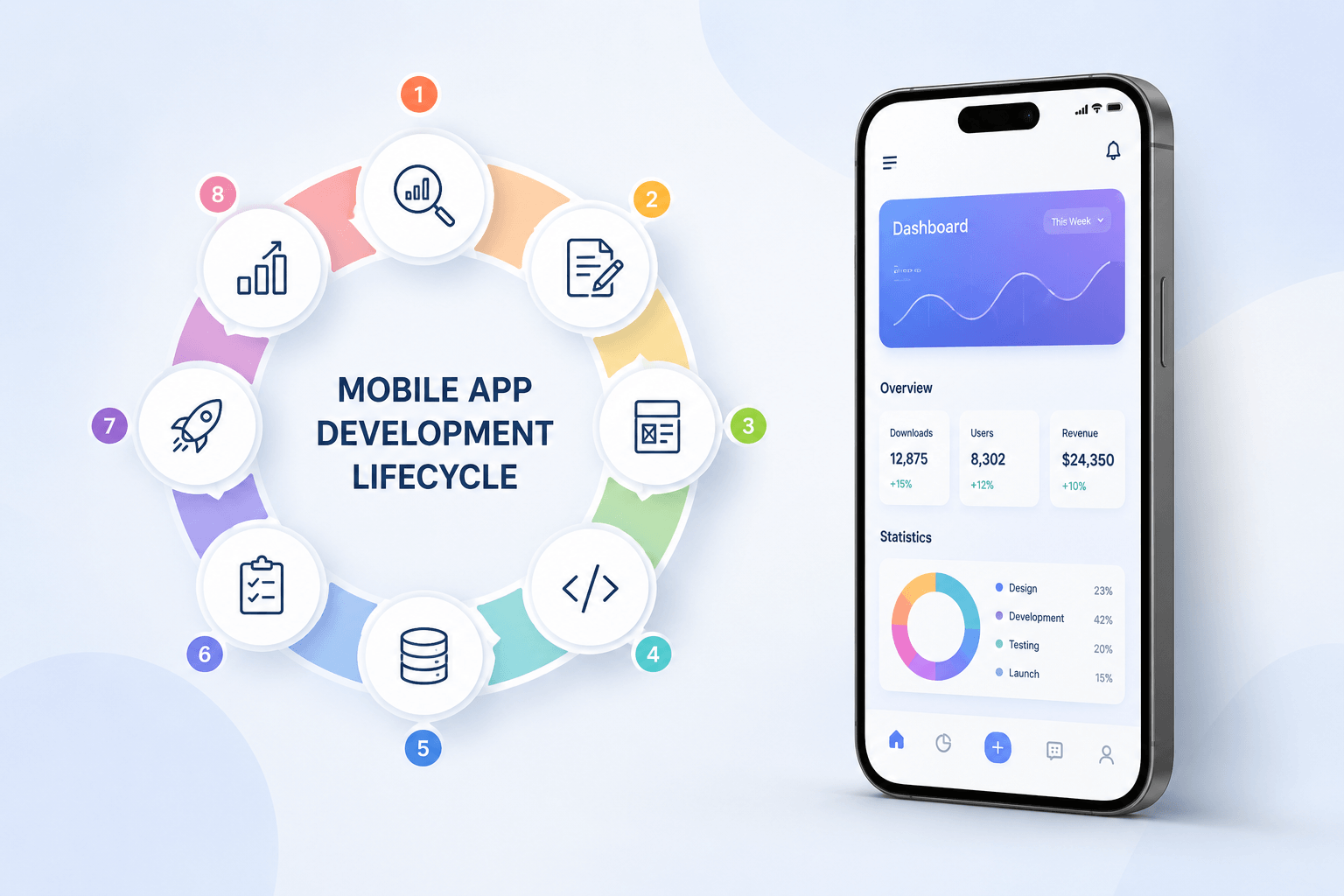
Mobile App Development Lifecycle: Complete 2026 Guide (8 Stages)
Book your consultation now
Related Post