
AI Mobile App Development Cost in 2026: Complete Pricing Guide
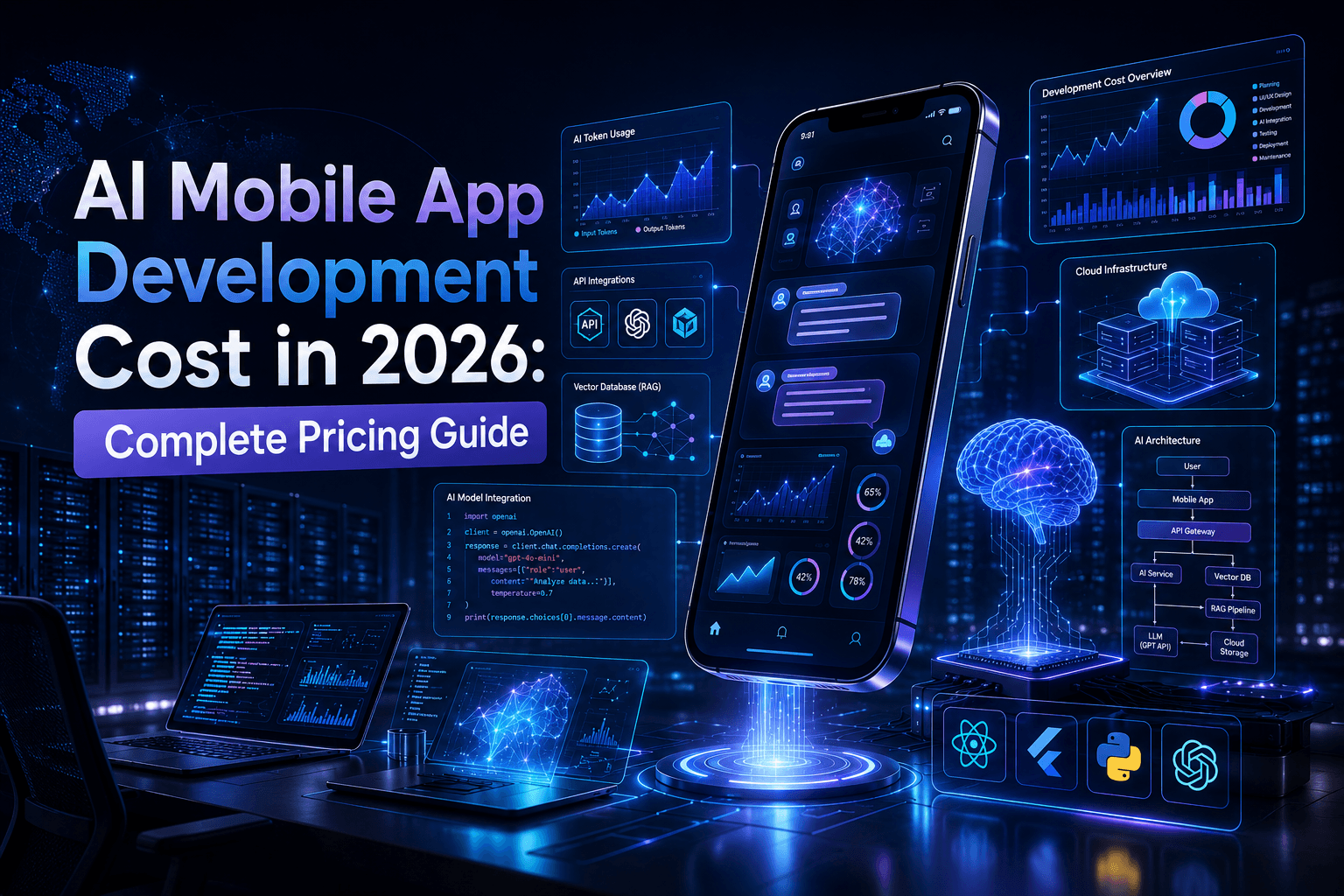
The global mobile ecosystem has fundamentally shifted. In 2026, building a mobile application without integrating machine learning or generative AI capabilities is equivalent to building a web page without mobile responsiveness a decade ago. Startups and enterprise brands are no longer asking if they should integrate artificial intelligence, but rather: How much does it cost to build an AI-powered mobile app in 2026?
To provide an immediate, data-driven baseline: The cost to build an AI-powered mobile app in 2026 ranges from $30,000 to over $250,000+. The exact figure depends heavily on infrastructure choices (e.g., fine-tuned open-source LLMs versus proprietary API orchestrations), real-time data processing demands, context window parameters, and the underlying mobile architecture.
This comprehensive pricing guide breaks down the financial dynamics of modern AI application development, analyzing hidden infrastructure costs, machine learning complexities, and strategic budgeting methodologies required to deploy a highly scalable product.
Quick Summary: 2026 AI App Development Costs
TL;DR: If you are seeking a fast architectural snapshot for stakeholder evaluation, this structured matrix breaks down the capital requirements and production timelines for modern intelligent applications in 2026.
|
AI App Complexity Tier |
Core Engineering Profile |
Average Cost Range |
Production Timeline |
|
API Wrapper App (MVP) |
OpenAI/Claude/Gemini APIs, Prompt Engineering, Streaming UI |
$30,000 – $55,000 |
4 – 8 Weeks |
|
Custom RAG / Multi-Agent |
Vector DBs (Pinecone), Custom Orchestration, Enterprise APIs |
$60,000 – $130,000 |
3 – 5 Months |
|
Bespoke Enterprise AI |
Fine-tuned LLMs, Edge AI, CoreML/NNAPI, Custom Datasets |
$140,000 – $250,000+ |
6 – 9+ Months |
The Core Breakdown: Cost by AI App Complexity
The cost structure of an AI application is determined by how deeply artificial intelligence is integrated into your operational logic, prompt management strategies, and vector data architecture.
1. Minimal/Wrapper AI Mobile Apps (MVP Level)
- Cost Range: $30,000 – $55,000
- Timeline: 4 – 8 weeks
- Technical Architecture: These apps utilize existing foundation models via commercial API endpoints (such as OpenAI’s GPT-4o, Anthropic’s Claude 3.5 Sonnet, or Google’s Gemini 1.5 Pro). The core development work focuses on frontend UI/UX engineering, basic prompt optimization, token rate-limiting, and simple API wrapper middleware.
- Ideal For: Minimal Viable Products (MVPs), automated AI copywriters, simple conversational interfaces, and basic productivity utilities. If you are starting fresh, planning a scalable base structure is critical—read our technical breakdown inside the How to Build a SaaS Mobile App in 2026: Complete Developer Guide (Cost, Stack & Timeline) to map this tier effectively.
2. Intermediate/Custom Orchestration AI Mobile Apps
- Cost Range: $60,000 – $130,000
- Timeline: 3 – 5 months
- Technical Architecture: This tier goes beyond basic API calls by implementing a custom Retrieval-Augmented Generation (RAG) pipeline or vector database architectures (such as Pinecone, Milvus, or pgvector). It integrates proprietary company data, connects to external enterprise APIs, and uses advanced multi-agent workflows to execute complex, multi-step actions.
- Ideal For: AI-driven healthcare diagnostics, personalized fintech investment advisors, intelligent property matchmakers, or multi-tenant SaaS platforms. Upgrading from a standard architecture to an intelligent system requires distinct engineering paths; follow our deep-dive analysis on How to Add AI to an Existing Mobile App (2026 Guide) to avoid breaking active codebases.
3. Advanced / Enterprise Custom-Trained AI Apps
- Cost Range: $140,000 – $250,000+
- Timeline: 6 – 9+ months
- Technical Architecture: Built for absolute domain dominance, these applications require fine-tuning open-source LLMs (like Llama 3.1, Mistral Large, or DeepSeek) on extensive custom datasets or training bespoke Computer Vision (CV) and Natural Language Processing (NLP) models from scratch. They feature native edge-AI computing capabilities using hardware acceleration frameworks like Apple CoreML and Android NNAPI.
- Ideal For: Autonomous logistics systems, real-time video/audio generative applications, ultra-secure cross-border fintech platforms, and complex enterprise software. For highly specialized systems that use autonomous agents, look into the operational budgets detailed in our AI Agent App Development Cost in 2026: Full Pricing Breakdown ($15K–$300K+) report.
2026 Cost Breakdown by Project Phase
A standard budget allocation for an AI-centric mobile application cannot rely solely on traditional software engineering matrices. Data pipeline development, vector indexing, and prompt engineering demand distinct capitalization.
|
Development Phase |
Percentage of Budget |
Estimated Cost (Mid-Tier App) |
Core Deliverables & Milestones |
|
Product Discovery & AI Feasibility |
10% |
$8,000 – $12,000 |
Token volume estimation, latency targets, model mapping |
|
UI/UX Design & Prototyping |
15% |
$12,000 – $18,000 |
Streaming response design, conversational UX patterns |
|
Data Engineering & Vector Pipelines |
15% |
$12,000 – $18,000 |
Extraction ETLs, chunking strategies, vector database indexing |
|
Frontend & Backend App Development |
35% |
$28,000 – $42,000 |
Cross-platform builds, API middleware, memory caching |
|
AI Tuning, Prompt Optimization & QA |
15% |
$12,000 – $18,000 |
Grounding evaluations, prompt testing, latency debugging |
|
Deployment, DevOps, & Cloud Infra |
10% |
$8,000 – $12,000 |
Serverless provisioning, CDN edge config, secure key storage |
The Modern Tech Stack Driving AI App Costs
The specific choices made within your technology stack have a compounding effect on both initial development expenditures and long-term maintenance costs.
- Cross-Platform Frameworks: Selecting the correct environment impacts both cost and delivery speed. Building with frameworks like React Native or Flutter reduces frontend coding costs by 30% to 40% compared to native development. It allows a single codebase to serve both iOS and Android while maintaining native bridge access to device-level AI accelerators. To determine which system matches your budget, review our breakdown on Android vs iOS vs Flutter vs React Native: Which Platform Should You Choose in 2026?.
- AI/ML Frameworks: PyTorch, TensorFlow, and Hugging Face Transformers are standard for model training and management. LangChain and LlamaIndex serve as the orchestration layer for managing context and agent behaviors.
- Backend Infrastructure: Serverless architectures (such as AWS Lambda, Google Cloud Functions, or FastAPI hosted on Dockerized AWS ECS instances) ensure that the app can scale its computing resources dynamically based on concurrent user queries.
Key Drivers of AI Mobile App Development Costs
To accurately forecast an AI development budget, product owners must understand the variables that escalate or optimize engineering hours.
1. Data Pipeline Engineering and Storage
AI models are only as effective as the data feeding them. Collecting, parsing, cleaning, and structuring unstructured data into high-dimensional vector embeddings requires specialized data engineering. If your application relies on real-time proprietary data syncing, expect engineering costs to scale accordingly.
2. Multi-Agent Workflows vs. Static Prompts
Deploying an app that relies on autonomous AI agents—where one agent validates user intent, a second queries a database, and a third formats the output—requires complex asynchronous state management. Orchestrating these multi-turn interactions demands meticulous logic design to prevent infinite loop errors and cascading API tokens.
3. Security and Regulatory Compliance
AI mobile applications handling sensitive information must implement stringent security guardrails. Complying with global data frameworks (such as GDPR, HIPAA for healthcare apps, or PCI-DSS for cross-border fintech) requires end-to-end data encryption, automated PII (Personally Identifiable Information) masking layers, and secure, audited LLM caching mechanisms.
The Ongoing Cost: Post-Launch AI App Maintenance
Launching an AI mobile app is only the initial step. The operational infrastructure for artificial intelligence introduces recurring maintenance fees that differ significantly from traditional mobile applications. To protect your runway, you must budget for these ongoing monthly operational expenses:
- Token Consumption & API Fees: Commercial foundation models bill per 1,000 tokens (across input prompts and output generations). High-volume consumer applications quickly incur heavy monthly costs if caching mechanisms are missing. This typically consumes roughly 40% of ongoing cloud budgets.
- Dedicated GPU Cloud Hosting: Teams hosting custom or fine-tuned open-source models on cloud infrastructure (like AWS Bedrock, Google Vertex AI, or RunPod) require dedicated GPU instances (e.g., NVIDIA H100 or A10G). This accounts for 35% of ongoing cloud budgets.
- Model Drift Correction & Evaluations: User behaviors shift and real-world data contexts change over time. Ongoing engineering resources must be allocated to monitor for model drift, refine prompt libraries, patch vector index tables, and run routine evaluation suites. This represents 25% of ongoing cloud budgets.
For a total financial breakdown of these hidden post-launch factors, read our comprehensive overview on How Much Does It Cost to Maintain a SaaS Mobile App Monthly in 2026?.
Strategies to Optimize Your AI App Development Budget
Building high-performance AI software does not require enterprise-scale capital. Startups can optimize their burn rate by utilizing strategic development practices:
- Launch with an AI-First MVP: Focus on solving a single problem exceptionally well using a combined frontend framework and a well-optimized third-party API wrapper before committing to custom model training. Check out our step-by-step roadmap on How to Build an MVP App for Your Startup in 2026 to minimize upfront risk.
- Implement Semantic Caching: Use caching layers (like GPTCache) on your backend servers. If a new user asks a question identical or semantically similar to a previous query, the app serves the cached response instantly instead of hitting the LLM vendor, cutting API token expenses by up to 40%.
- Hire a Dedicated Full-Cycle Developer: Avoid the communication overhead and fractured codebases that come with managing siloed teams of designers, backend engineers, and data analysts. Partnering with a senior, end-to-end development specialist streamlines your operational pipeline. Learn how to verify qualifications and avoid hiring risks by reading our guide on How to Hire a Dedicated Mobile App Developer in 2026 (Cost, Rates, Checklist & Red Flags).
Get best mobile app development services
Develop your business app
Conclusion
Partner with an Expert AI Mobile App Developer
Building an AI-powered mobile app in 2026 is an engineered journey that requires balancing advanced algorithmic design with pragmatic cost controls. Whether your product goal is a lean API-driven MVP or a highly complex, multi-tenant enterprise system with native RAG orchestration, success relies entirely on structural execution and deep technical experience.
Partner with an expert who brings over 22 years of application development mastery and a portfolio of 550+ successfully delivered global mobile solutions. Let’s convert your complex AI product roadmap into an optimized, highly scalable commercial reality.
Ready to calculate your custom project blueprint? Schedule a Free Technical Consultation with Mr Mobile App Developer Today and let’s build the future of your industry together.
Quality Service For You
We deliver unique and blended experiences to our customers across the globe. From idea to execution and launch, we do ALL.
Backend Development:
Table of Contents
Why Mobile Apps Fail After Launch: 15 Common Reasons and How to Prevent Them
How to Calculate ROI for Mobile App Development in 2026
Mobile App Development Lifecycle: Complete 2026 Guide (8 Stages)

Book your consultation now
Related Post