
Why Mobile Apps Fail After Launch: 15 Common Reasons and How to Prevent Them
Quick Answer: Most mobile apps fail after launch not because of bad code, but because of decisions made before and after that code ships — skipping market validation, ignoring retention, weak App Store Optimization, poor security, and treating launch day as the finish line instead of the starting point. Fixing these 15 issues before and immediately after launch is what separates apps that survive from the roughly 25% of apps abandoned after a single use. |
Launching an app feels like the finish line. It isn’t. Industry data consistently shows that a large share of downloaded apps are opened once and never again, and most apps that do stick around still lose the majority of their users within the first 90 days. The apps that survive aren’t the ones with the biggest budgets — they’re the ones built to avoid a specific, repeatable set of mistakes.
Below are the 15 most common reasons apps fail after launch, drawn from patterns we see across client projects, along with the fix for each one.
Quick Reference: 15 Reasons Apps Fail After Launch
# | Reason | Fastest Fix |
1 | No validated market demand | User interviews before writing a line of code |
2 | Confusing or bloated onboarding | Cut onboarding to 3 screens or fewer |
3 | Slow performance and lag | Set a 2-second load-time budget |
4 | Feature bloat | Ship one core feature exceptionally well |
5 | No retention strategy | Build a habit loop before launch, not after |
6 | Skipped post-launch maintenance | Budget 15–25% of build cost annually |
7 | Weak security | Follow OWASP Mobile Top 10 from day one |
8 | Poor App Store Optimization | Treat ASO as a launch deliverable, not an afterthought |
9 | Ignoring user reviews and feedback | Reply to every review within 48 hours |
10 | No clear monetization plan | Validate willingness to pay before scaling |
11 | App store rejections and resubmission delays | Pre-review against Apple/Google guidelines |
12 | Update stagnation | Ship a meaningful update at least monthly |
13 | Poor UI/UX design | Usability-test with 5 real users pre-launch |
14 | No scalability planning | Load-test before any PR or marketing push |
15 | No post-launch marketing plan | Budget for user acquisition, not just development |
1. Building an App Nobody Actually Needed
The single biggest reason apps fail traces back to before development even started: no one confirmed real demand existed. Founders build for an assumption, not a validated problem, and by launch day the market says no.
How to prevent it: Run structured user interviews, map the jobs-to-be-done, and study what your target users are already doing to solve this problem today. If they’ve cobbled together a workaround using spreadsheets, WhatsApp groups, or a competitor’s app, that’s a signal of real demand. If nobody can describe the pain point without prompting, the app doesn’t have a market yet.
2. Onboarding That Loses Users in the First 60 Seconds
Users decide whether to keep an app within their first session, often within the first minute. An onboarding flow that demands account creation, permissions, and a tutorial before showing any value gets abandoned.
How to prevent it: Get users to their “aha moment” — the point where the app’s value becomes obvious — in three screens or fewer. Delay account creation until after the user has experienced something worth signing up for.
3. Slow Load Times and Laggy Performance
A one-second delay in load time can measurably reduce conversions and engagement. Apps that lag, freeze, or take more than a couple of seconds to respond train users to expect frustration, and they leave.
How to prevent it: Set a hard performance budget — under 2 seconds for cold start, under 100ms for interactions — and test on mid-range devices, not just flagship phones. Most of your actual user base isn’t testing on the latest iPhone.
4. Feature Bloat: Trying to Do Everything at Once
Teams add features to compete on paper, and the result is an app that does ten things adequately instead of one thing exceptionally. Users facing too many options experience decision paralysis and often abandon the app entirely rather than learn a complex system.
How to prevent it: Identify the single core action your app needs to nail, strip everything else from the first release, and add features only after usage data proves people want them.
5. No Retention Strategy Beyond the Download
Downloads are a vanity metric. Retention is what determines whether an app survives. Teams that pour their budget into launch marketing and treat retention as a “later” problem consistently see steep drop-off in the first week.
How to prevent it: Design a habit loop — trigger, action, reward — into the product before launch. Push notifications, streaks, and re-engagement emails only work if there’s an underlying reason to come back; identify that reason first.
6. Skipping Post-Launch Maintenance
Apps aren’t a one-time build. iOS and Android both ship major OS updates annually, and apps that don’t keep pace lose compatibility, crash on newer devices, or get pulled from the store entirely. The industry standard is to budget roughly 15–25% of the original development cost every year for maintenance — covering OS compatibility, bug fixes, and security patches. Teams that skip this line item almost always regret it within 12–18 months.
How to prevent it: Treat maintenance as a recurring budget line from day one, not a surprise expense. Set aside the percentage before launch, not after the first crash spike.
7. Security Gaps That Surface After Real Users Arrive
Security issues that seem theoretical during development become very real once an app has live user data. Hardcoded API keys, unencrypted local storage, and missing server-side validation are the most common culprits, and they’re rarely caught until a breach or an App Store security flag forces the issue.
How to prevent it: Build against the OWASP Mobile Top 10 from the first sprint, encrypt data in transit and at rest, and run a security review before every major release rather than only before the first one.
8. Poor App Store Optimization (Nobody Can Find the App)
A well-built app that nobody can find is functionally the same as an app that doesn’t exist. Around 65% of app downloads originate from app store search, yet most teams spend the bulk of their launch effort on the product and almost none on the title, keywords, screenshots, and description that determine whether the app shows up at all.
How to prevent it: Treat App Store Optimization as a launch deliverable with the same priority as the build itself — keyword-researched titles and subtitles, conversion-focused screenshots, and a description that matches actual search intent.
9. Ignoring Reviews and User Feedback
Negative reviews left unanswered compound. They signal to future users — and to the store’s ranking algorithm — that the app is abandoned or unsupported, which suppresses both downloads and rankings.
How to prevent it: Respond to every review, positive or negative, within 48 hours. Treat recurring complaints as a prioritized backlog rather than noise, since store algorithms increasingly weight review velocity and recency alongside star rating.
10. No Clear Monetization Strategy
Apps that bolt on monetization after the fact — a paywall added six months post-launch, ads inserted reactively — tend to alienate the exact users who were sticking around. Revenue strategy decided too late almost never fits the product cleanly.
How to prevent it: Decide the monetization model (subscription, one-time purchase, freemium, ads, transaction fees) during the planning phase, and validate willingness to pay before scaling acquisition spend. If you’re still shaping the budget side of this decision, our guide to eCommerce app development cost breaks down how pricing and monetization choices affect the build itself.
11. Getting Rejected at the App Store Stage
App store rejections don’t just delay launch — repeated rejections push back marketing timelines, burn budget on resubmissions, and in some cases cause teams to miss a planned launch window entirely. The most common causes are crashes during review, incomplete metadata, missing privacy policies, and payment policy violations.
How to prevent it: Run a pre-submission checklist against the current App Store rejection reasons before every submission, not just the first one. Most rejections are avoidable with a thorough internal review before the app ever reaches a human reviewer.
12. Update Stagnation
An app that hasn’t been updated in months signals abandonment to both users and store algorithms. Outdated apps lose visibility in search rankings, and users interpret a lack of updates as a lack of support.
How to prevent it: Ship a meaningful update — a fix, a feature, a performance improvement — at least monthly. Consistency matters more than scale; small, frequent updates outperform rare, large ones for both rankings and user trust.
13. Poor UI/UX Design
Confusing navigation, inconsistent design patterns, and interfaces that don’t match platform conventions (iOS users expect iOS patterns, Android users expect Android patterns) create friction that compounds with every screen.
How to prevent it: Usability-test with five real target users before launch — this typically surfaces the majority of critical usability issues. Fix what breaks the flow before fixing what looks unpolished.
14. No Scalability Planning
Some of the most visible app failures happen at the moment of apparent success: a press mention or a viral moment drives a spike in users, and the backend — built for early-stage traffic — can’t handle it. The app crashes exactly when it has the most eyes on it.
How to prevent it: Load-test infrastructure before any marketing push, press outreach, or paid campaign, not after. Architecture decisions that felt like reasonable shortcuts at 500 users become expensive failures at 50,000.
15. No Post-Launch Marketing Plan
Teams that spend their entire budget on development arrive at launch with nothing left for user acquisition. An app with zero marketing plan behind it gets zero organic traction, no matter how well it’s built.
How to prevent it: Budget for post-launch marketing as a separate, non-negotiable line item during planning — not something to figure out after the build is done. ASO, a content strategy, and a modest paid acquisition test should all be planned before the app ships, not after it quietly fails to gain traction.
Frequently Asked Questions
Why do most apps fail within the first 90 days?
Most failures in the first 90 days trace back to weak retention design — users try the app once, don’t find a reason to return, and uninstall. The first three months are when the gap between “downloaded” and “actually useful” becomes visible.
What percentage of apps fail after launch?
Estimates vary by source, but it’s widely reported that around a quarter of downloaded apps are opened only once, and a large majority of apps lose most of their user base within the first few months of launch.
Is app failure usually a technical problem or a business problem?
More often a business and strategy problem. Technical excellence alone doesn’t guarantee success — apps with clean code and zero crashes still fail when they solve a problem nobody has, or when retention and monetization were never planned for.
How much should I budget for after launch, not just development?
Plan for roughly 15–25% of your build cost per year in ongoing maintenance, plus a separate budget for App Store Optimization and user acquisition. Treating launch as the end of the budget is one of the most common reasons apps stall.
Can an app recover after a weak launch?
Yes, if the core product has genuine value. Recovery usually requires a retention-focused audit — fixing onboarding, addressing top user complaints, and rebuilding ASO — rather than a full rebuild.
Get best mobile app development services
Develop your business app
Conclusion
Understanding why mobile apps fail after launch helps you avoid costly mistakes. Validate demand, prioritize user experience, maintain performance and security, listen to feedback, and keep improving after launch. A successful app is not just built well, it is continuously optimized to meet user needs.
Quality Service For You
We deliver unique and blended experiences to our customers across the globe. From idea to execution and launch, we do ALL.
Backend Development:
Table of Contents
Why Mobile Apps Fail After Launch: 15 Common Reasons and How to Prevent Them

How to Calculate ROI for Mobile App Development in 2026
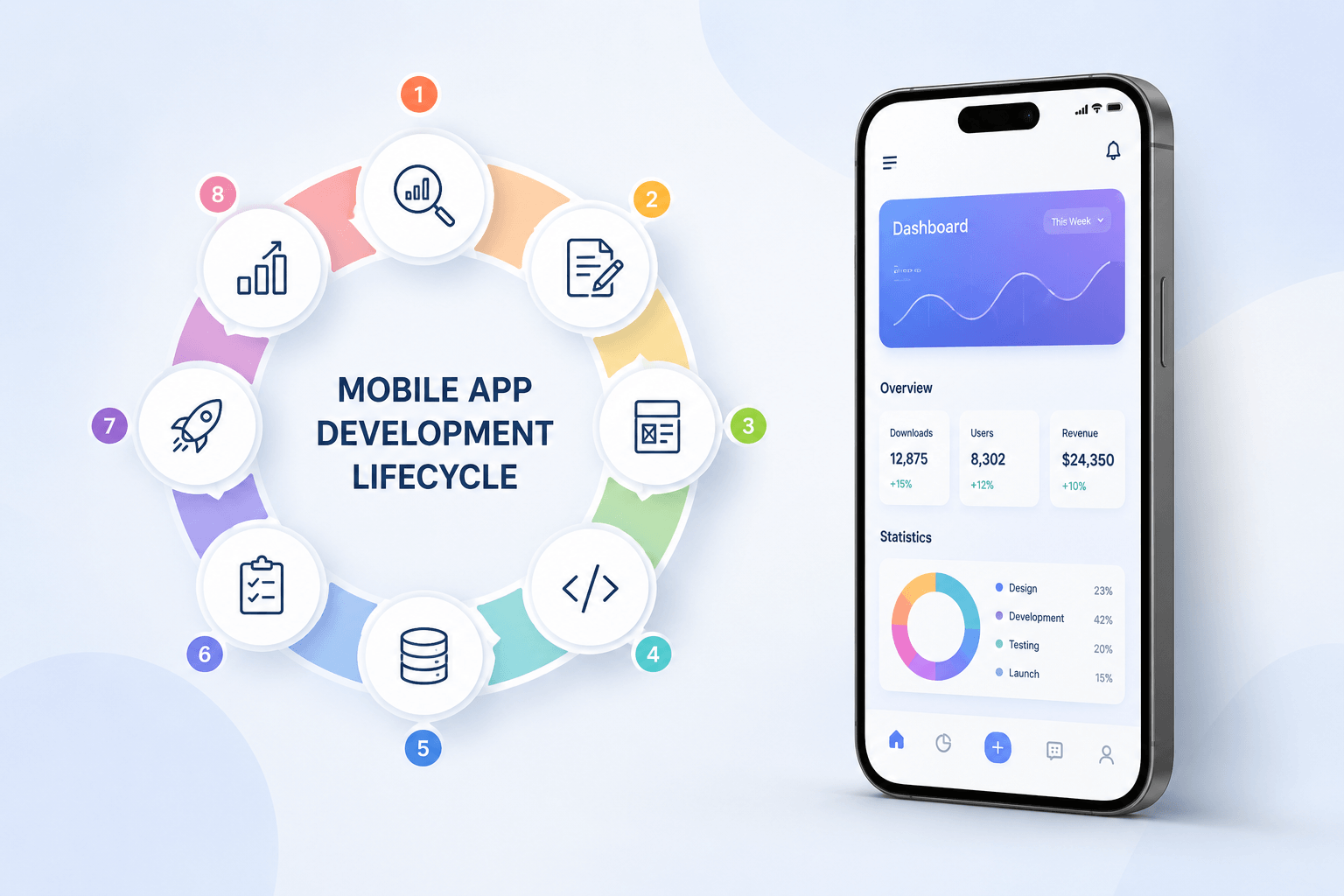
Mobile App Development Lifecycle: Complete 2026 Guide (8 Stages)

Book your consultation now
Related Post