
Mobile App Development Lifecycle: Complete 2026 Guide (8 Stages)
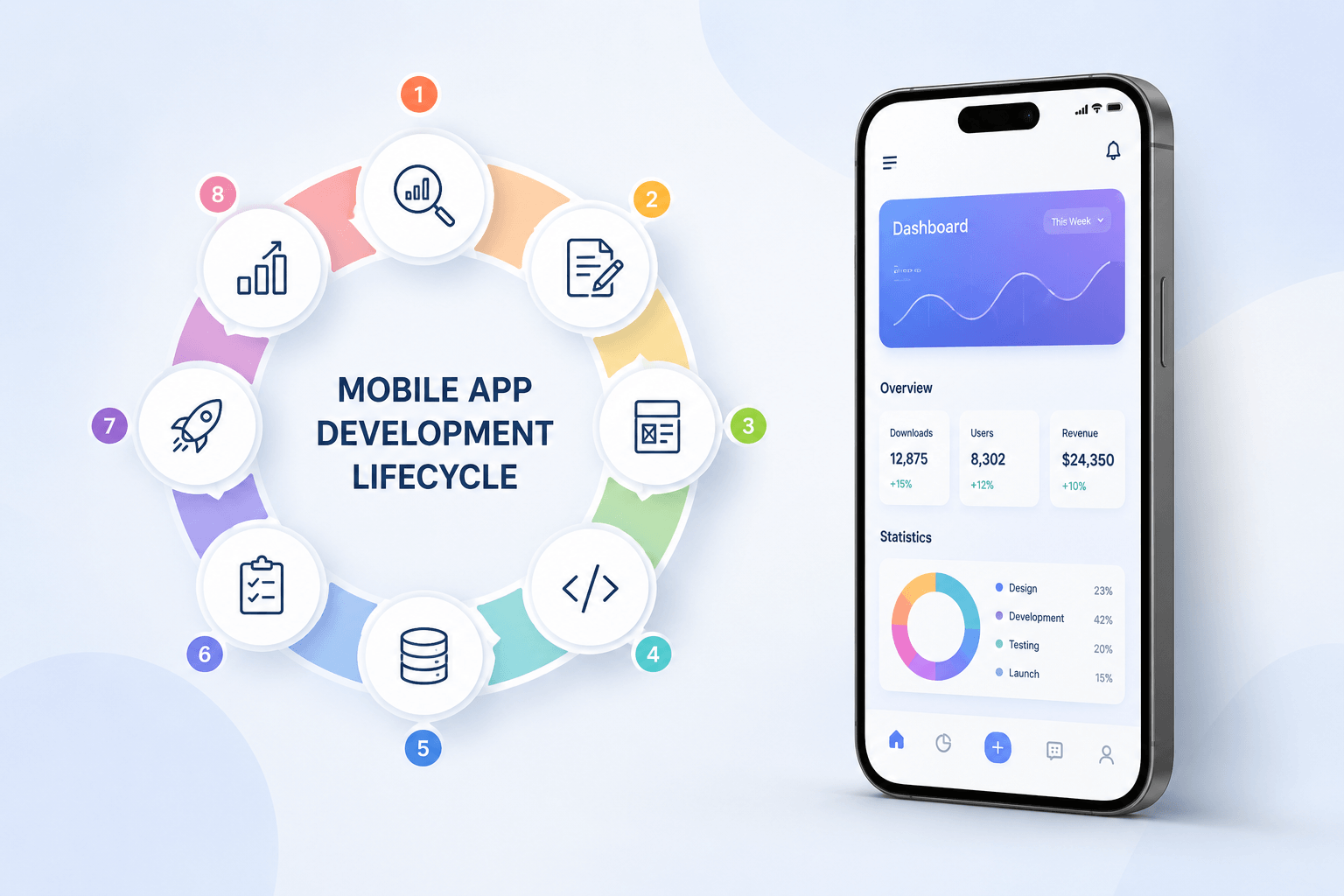
Quick Answer
The mobile app development lifecycle is the complete, recurring cycle an app moves through — from ideation and planning, through design, development, testing, and launch, to post-launch maintenance, iteration, and eventual retirement. Unlike a one-time development process, the lifecycle is circular: user feedback and performance data from the maintenance stage feed back into planning for the next release, and this loop repeats for as long as the app is active. Most apps cycle through 8 core stages, and most teams follow one of three SDLC models — Waterfall, Agile, or Spiral — to manage that cycle.
What Is the Mobile App Development Lifecycle?
The mobile app development lifecycle (sometimes called Application Lifecycle Management, or ALM) refers to the full span of an app’s existence — not just the work needed to ship version 1.0, but everything that happens before, during, and after launch, including the updates, iterations, and eventual retirement that follow.
This is a subtle but important distinction from the mobile app development process, which usually describes the linear sequence of steps a team follows to take an app from idea to App Store submission. The process ends at launch. The lifecycle doesn’t — it treats launch as the midpoint of a continuous loop, not the finish line.
Think of it this way: the process is the recipe. The lifecycle is the recipe plus everything that happens after the meal is served — feedback, reordering, menu changes, and eventually retiring the dish altogether.
If you’re specifically looking for the step-by-step build sequence, our mobile app development process guide walks through that in detail. If you want to know how long each stage typically takes, see our mobile app development timeline guide. This guide focuses on the full lifecycle model — the stages, the methodologies, and what happens once the app is live.
The 8 Stages of the Mobile App Development Lifecycle
# | Stage | Primary Output | Typical Owner |
1 | Ideation & Market Research | Validated concept, competitor analysis | Founder / Product |
2 | Strategy & Planning | Roadmap, PRD, tech stack decision | Product Manager |
3 | UI/UX Design | Wireframes, prototypes, design system | UI/UX Designer |
4 | Development | Working front-end and back-end code | Developers |
5 | Testing & QA | Bug-free, stable build | QA Engineers |
6 | Deployment & Launch | Live app on App Store / Play Store | DevOps / Developer |
7 | Maintenance & Updates | Stable, current, secure app | Support / Dev team |
8 | Iteration & Sunset | New releases or planned retirement | Product / Leadership |
1. Ideation & Market Research
Every lifecycle begins with validating that the app idea solves a real problem for a real audience. This stage involves identifying the target user, studying competitors, and confirming there’s enough demand to justify building the app at all. Skipping this step is the single biggest reason apps fail post-launch — not because of bugs, but because nobody needed the app in the first place. See our guide on how to validate an app idea before development for a structured 7-step approach.
2. Strategy & Planning
Once the idea is validated, the team defines scope, budget, platform (iOS, Android, or both), monetization model, and a feature list — usually formalized in a Product Requirements Document (PRD) and a business plan. This is also where the MVP (minimum viable product) gets scoped, so the first release stays lean instead of trying to ship everything at once. Related reading: how to write an app requirements document, how to create an app business plan, and how to build an MVP for your startup.
3. UI/UX Design
Designers translate the requirements into wireframes, clickable prototypes, and a visual design system. Good UX design at this stage prevents expensive rework later — restructuring a user flow after development starts costs significantly more than fixing it on a wireframe.
4. Development
This is where code gets written — front-end (what users see and interact with) and back-end (servers, databases, APIs) built in parallel or in short iterations, depending on the methodology used. Platform choice matters here: see our comparison of Android vs iOS vs Flutter vs React Native if you haven’t locked in a tech stack yet.
5. Testing & QA
Before release, the app goes through functional testing, performance testing, security testing, and device/OS compatibility testing. This stage also catches the kinds of issues that lead to App Store rejections — our guide on App Store rejection reasons and how to avoid them covers the most common ones. Security testing specifically should reference the OWASP Mobile Top 10.
6. Deployment & Launch
The app is submitted to the App Store and/or Google Play, along with store listing assets — screenshots, descriptions, keywords. A well-optimized listing at this stage directly affects discoverability; see how to optimize your mobile app for the App Store.
7. Maintenance & Updates
This is the stage that separates the process from the lifecycle. Once live, the app needs OS-compatibility updates, bug fixes, security patches, and performance monitoring on an ongoing basis. Budgeting for this is essential and frequently underestimated — our complete app maintenance cost guide breaks down typical annual costs.
8. Iteration & Sunset
Feedback and analytics from the maintenance stage feed directly back into planning — new features get prioritized, underused ones get cut, and the cycle repeats. Eventually, every app reaches a decision point: continued investment, a major rebuild, or planned retirement (sunsetting) if it no longer serves the business. This closes the loop and is what makes the lifecycle circular rather than linear.
SDLC Models: How Teams Manage the Lifecycle
Most teams manage the mobile app development lifecycle using one of three Software Development Life Cycle (SDLC) models:
Model | How It Works | Best For | Trade-off |
Waterfall | Each stage completes fully before the next begins | Fixed-scope projects with well-defined requirements | Inflexible — expensive to change direction mid-build |
Agile | Work happens in short sprints (1–2 weeks), with continuous testing and feedback | Startups and evolving products | Requires close, ongoing collaboration with stakeholders |
Spiral | Combines iterative development with structured risk analysis at each loop | Large, complex, or high-risk enterprise apps | Slower and more resource-intensive than Agile |
Agile is the model most commonly used for mobile apps today because it aligns naturally with the lifecycle’s circular nature — each sprint essentially runs a miniature version of stages 3 through 7.
Mobile App Lifecycle vs. Mobile App Development Process — What’s the Difference?
| Development Process | Development Lifecycle |
Scope | Idea → App Store submission | Idea → ongoing use → retirement |
Shape | Linear (has an end point) | Circular (repeats indefinitely) |
Ends at | Launch | Never — until the app is sunset |
Includes maintenance? | No | Yes — it’s a core stage |
If your team is only planning the build, the process guide is the more relevant read. If you’re budgeting for the app’s full life — including years two, three, and beyond — the lifecycle model above is what to plan against.
Cost & Time Across the Lifecycle
Development itself (stages 1–6) is typically only 60–70% of an app’s total lifetime cost. The remaining 30–40% goes toward stages 7 and 8 — maintenance, OS updates, and iteration — spread across the app’s active years. For a realistic full-picture budget, pair our app development cost breakdowns with the maintenance cost guide rather than budgeting for launch alone.
Choosing a Partner for the Full Lifecycle — Not Just the Build
Many businesses hire a developer or agency to reach launch, then scramble to find maintenance support afterward. It’s more cost-effective — and safer for app stability — to choose a partner who can support the full lifecycle from day one. When evaluating options, see how to choose the right mobile app development company and freelance developer vs. agency: the honest 2026 decision guide.
Frequently Asked Questions
What are the 8 stages of the mobile app development lifecycle?
Ideation & market research, strategy & planning, UI/UX design, development, testing & QA, deployment & launch, maintenance & updates, and iteration & sunset.
Is the mobile app development lifecycle the same as SDLC?
They’re closely related. SDLC (Software Development Life Cycle) refers to the methodology used to manage the work — Waterfall, Agile, or Spiral. The mobile app development lifecycle is the full set of stages that methodology is applied to, including what happens after launch.
How long does a full app lifecycle last?
There’s no fixed end date — a well-maintained app can stay in the maintenance-and-iteration loop for years. Most businesses budget in 12-month cycles, reviewing whether to continue investing, rebuild, or retire the app annually.
What is app sunsetting?
Sunsetting is the planned retirement of an app — usually because it no longer serves the business, has been replaced by a newer product, or the cost of maintaining it outweighs its value.
Do I need a different team for the maintenance stage?
Not necessarily. Many teams that build the MVP also handle long-term maintenance, which avoids the ramp-up time a new team would need to learn the codebase. Mobile support & maintenance is worth setting up before launch, not after.
Get best mobile app development services
Develop your business app
Conclusion
The mobile app development lifecycle doesn’t end when an app launches. From ideation and planning to design, development, testing, launch, maintenance, and continuous improvement, each stage plays an important role in building a successful long-term product. Understanding the full lifecycle helps businesses plan better, control costs, improve user experience, and keep their app secure and competitive for years.
Quality Service For You
We deliver unique and blended experiences to our customers across the globe. From idea to execution and launch, we do ALL.
Backend Development:
Table of Contents
Why Mobile Apps Fail After Launch: 15 Common Reasons and How to Prevent Them
How to Calculate ROI for Mobile App Development in 2026
Mobile App Development Lifecycle: Complete 2026 Guide (8 Stages)

Book your consultation now
Related Post