How to Create an App Business Plan in 2026

A Step-by-Step Startup Guide (With Free Template)
An app business plan is the document that proves your app idea is a viable business — not just a good idea. This guide walks you through all 12 sections investors, co-founders, and developers expect to see in 2026, with a free downloadable template, real cost benchmarks, and the exact mistakes that sink first-time founders.
Table of Contents
What Is an App Business Plan? (Quick Answer)
An app business plan is a structured document that defines the problem your app solves, who it serves, how it makes money, what it costs to build and run, and how you will acquire users and reach profitability. Unlike a Product Requirements Document (PRD), which defines what the app does, a business plan defines why the business works — the market, the model, the money.
You need an app business plan in 2026 if you’re raising funding, applying for a business loan, recruiting a co-founder or technical partner, or simply want to avoid building a product nobody will pay for. According to CB Insights, 35% of startups fail because there’s no real market need for the product — a business plan is the cheapest insurance against becoming that statistic.
In this guide, you’ll learn:
- The 12 essential sections every 2026 app business plan needs
- How to size your market with TAM/SAM/SOM (with a worked example)
- Realistic 2026 cost benchmarks for MVP, mid-complexity, and enterprise apps
- How to choose a monetization model that actually fits your app type
- A free, copy-paste business plan template and checklist
- The 7 mistakes that make investors and developers reject a plan instantly
Quick Tip: If you already have a validated idea and just need to scope features and tech, you may be further along than you think — check out our companion guide, How to Turn an Idea Into an App in 2026, which picks up right where market validation ends.
Step 1: Validate the Problem Before You Plan the Business
Every section of your business plan — market size, pricing, marketing spend — is built on one assumption: that real people have the problem you’re solving and will pay to fix it. Validate this first, or every later section is built on guesswork.
How to Validate Your App Idea in 2026
- Write the problem in one sentence: “My app helps [target user] do [specific action] so they can [achieve outcome].”
- Research existing demand using Google Trends, App Store/Play Store rankings, Reddit, and Product Hunt.
- Conduct 15–20 short interviews with real potential users — listen, don’t pitch.
- Build a no-code landing page (Carrd or Webflow) with a waitlist signup to capture real intent.
- Study 3–5 direct competitors. Zero competitors usually means zero market, not zero competition.
We cover this validation process in much greater depth — including the exact validation checklist used for client projects — in our guide How to Turn an Idea Into an App in 2026. If you haven’t validated yet, start there before finishing this plan.
Step 2: Write the Executive Summary
The executive summary is the one page that gets read by busy investors, banks, and partners. Write it last, but place it first. It should let someone fully understand your app business in under two minutes.
What to Include
- App name, tagline, and one-paragraph description
- The problem and your solution
- Target market and market size (summarized from Step 3)
- Business and revenue model
- Current stage (idea, MVP, live, revenue-generating)
- Funding ask and use of funds, if applicable
- Founding team’s relevant experience
Example: “FitTrackPro is a cross-platform fitness app for time-poor professionals aged 25–45 who abandon generic workout apps within two weeks. We use AI-personalized routines and habit nudges to lift 30-day retention above industry average. Freemium model with a $9.99/month Pro tier. Currently at MVP stage with 400 waitlist signups; raising $150K seed to fund an 8-month runway to product-market fit.”
Step 3: Market and Competitor Analysis
Size Your Market: TAM, SAM, SOM
Investors and your own planning both need a credible, bottoms-up market size — not a vague “mobile apps are a $935 billion market” statistic.
Metric | Definition | Example |
TAM | Total Addressable Market — everyone who could theoretically use an app like yours, globally | $935B global app market |
SAM | Serviceable Addressable Market — the segment you can realistically reach given your model/geography | $2.1B fitness-app segment, English-speaking markets |
SOM | Serviceable Obtainable Market — the share you can realistically capture in 1–3 years | $4.2M (0.2% of SAM in Year 2) |
Competitor Analysis Table
List 4–6 direct and indirect competitors. Investors check this section closely — vague or missing competitor analysis is one of the fastest ways a plan gets rejected.
Competitor | Pricing | Strength | Your Differentiation |
Competitor A | $12.99/mo | Large user base | Faster onboarding, AI personalization |
Competitor B | Free + ads | No paywall | Better retention via habit design |
Competitor C | $199 one-time | Loyal niche | Subscription model, continuous updates |
Step 4: Define Your Target Users and Personas
Apps built for “everyone” get downloaded by no one. Your business plan needs 2–3 sharp personas that drive every later decision — features, pricing, and marketing channel.
Persona Template
Field | Example |
Name & Age | Priya, 32 |
Occupation & Income | Marketing Manager, $65K/year |
Tech Behavior | iOS user, 5+ apps used daily, commutes 40 min/day |
Pain Point | Can’t stay consistent with workouts on a busy schedule |
Buying Trigger | Wants accountability and data, not just a stopwatch |
Step 5: Define Your Product and MVP Scope
This section of your business plan summarizes what you’re building — full detail belongs in a dedicated Product Requirements Document (PRD), but your business plan needs enough scope clarity to justify your budget and timeline.
Use the MoSCoW Method to Scope Your MVP
- Must Have — core features the app cannot function without (login, core workflow, payment)
- Should Have — important but not launch-blocking (notifications, filters)
- Could Have — nice-to-haves (dark mode, social sharing)
- Won’t Have (Now) — explicitly deferred to v2 (gamification, advanced AI)
Rule of thumb: if your MVP takes more than 3–4 months to build, it isn’t minimal enough. Cut features ruthlessly.
For startups that want a lean first version built fast, our MVP & Bespoke Solutions for Startups service is built specifically around this scoping discipline.
Step 6: Choose Your Business and Monetization Model
Your monetization model should match your app category — not the model that’s trending. Pick wrong here and your financial projections in Step 9 will be fiction.
Model | Best For | 2026 Benchmark |
Freemium + Subscription | Productivity, fitness, content apps | 2–5% free-to-paid conversion |
Subscription-only (SaaS) | B2B tools, professional services apps | $9.99–$49.99/month typical |
Marketplace Commission | Two-sided platforms (services, goods) | 10–20% take rate |
In-App Purchases | Games, content unlocks | Highly variable, hit-driven |
One-Time Purchase | Utility apps, niche tools | Declining in popularity since 2023 |
Ad-Supported | High-scale consumer apps only | Needs 100K+ MAU to be meaningful |
Step 7: Tech Stack and Development Plan
Your business plan doesn’t need engineering-level detail, but it must show you’ve made deliberate platform and technology decisions — this is one of the first things technical investors and development partners check.
Platform Decision
- Native (Swift/Kotlin) — best performance, highest cost, use for AR/hardware-heavy apps
- Cross-platform (Flutter, React Native) — one codebase, ~60–70% cost savings, the default choice for most 2026 startups
- No-code (Bubble, FlutterFlow) — fastest for early prototypes, not recommended for scalable products
If you’re leaning cross-platform, our React Native App Development Cost in 2026 guide breaks down realistic pricing by feature complexity — useful for building the budget table in Step 9.
Step 8: Marketing and Go-to-Market Strategy
Pre-Launch (4–8 Weeks Before Launch)
- Build an email waitlist via your validation landing page
- Line up 5–10 beta testers willing to leave Day-1 App Store reviews
- Prepare a Product Hunt launch for a Monday for maximum visibility
- Draft App Store Optimization (ASO) assets: keywords, screenshots, preview video
Post-Launch Channels to Budget For
- ASO and organic App/Play Store search
- Paid user acquisition (Meta, Google UAC, TikTok) — budget $2–$8 CPI depending on category
- Content marketing and SEO (blog, comparison pages, founder-led content)
- Referral and community-led growth loops
Step 9: Financial Plan and Budget
Realistic 2026 App Development Cost Benchmarks
App Type | Timeline | Cost Range (USD) |
No-code MVP | 2–6 weeks | $2,000 – $10,000 |
Simple MVP (1 platform) | 3–4 months | $8,000 – $25,000 |
Mid-complexity cross-platform app | 4–6 months | $25,000 – $75,000 |
Complex platform (SaaS/marketplace/AI) | 6–12 months | $75,000 – $300,000+ |
Budget Allocation Template
Component | % of Budget | Notes |
UI/UX Design | 15–20% | Figma prototyping, user testing |
Frontend/App Development | 30–35% | Largest line item |
Backend Development | 25–30% | APIs, database, auth, integrations |
QA & Testing | 10–15% | Don’t cut this to save money |
Deployment & DevOps | 5–8% | App Store/Play Store, hosting setup |
Contingency Buffer | 10–15% | Always include — scope creep is universal |
Don’t forget ongoing costs: budget 15–20% of your original build cost annually for maintenance, OS updates, and bug fixes — this is the single most underestimated line item in founder financial plans.
Step 10: Funding Strategy (If You’re Raising Capital)
Common Funding Sources for App Startups in 2026
Source | Typical Range | Best Fit |
Bootstrapping | Founder savings | Lean MVPs, no immediate scale pressure |
Friends & Family | $10K – $50K | Pre-seed, idea validated but no MVP |
Angel Investors | $25K – $250K | Working MVP with early traction |
Pre-Seed/Seed VC | $250K – $2M | Clear market signal, repeatable growth loop |
Startup Loans/Grants | Varies by region | Non-dilutive, slower to access |
Whichever source you target, your business plan’s financial section needs a clear “use of funds” breakdown and a 12–18 month runway projection — vague funding asks are an instant red flag for any serious investor.
Step 11: Team and Operations Plan
Investors fund teams as much as ideas. This section should answer: who builds it, who runs it, and who maintains it after launch.
- Founding team bios and relevant domain experience
- Build approach: in-house team, freelance developer, or agency (include cost comparison)
- Post-launch support: who handles bug fixes, OS updates, and customer support
- Org chart for the first 12 months, even if it’s just 2–3 roles
If you’re still deciding between hiring in-house, a freelancer, or an agency, this decision and its cost tradeoffs are covered in detail in our idea-to-app guide, which compares in-house, freelance, agency, and offshore models side by side.
Step 12: Milestones, KPIs, and Risk Assessment
Milestones to Include
- MVP development complete (target date)
- Beta launch with X users
- Public launch on App Store / Google Play
- First revenue / first 1,000 paying users
- Break-even point
KPIs to Track Post-Launch
Metric | Why It Matters | Healthy 2026 Benchmark |
Day 30 Retention | Signals real product-market fit | Above 25% |
CAC (Customer Acquisition Cost) | Determines if growth is sustainable | Below 1/3 of LTV |
Activation Rate | % reaching the “aha moment” in session one | Above 40% |
Churn Rate (subscriptions) | Revenue stability indicator | Below 5–7% monthly |
App Store Rating | Impacts algorithmic visibility | Above 4.2 stars |
Risk Assessment
- Market risk: What if a larger competitor launches a similar feature?
- Technical risk: What if a key integration (payments, AI API) changes pricing or terms?
- Financial risk: What’s your runway if user acquisition costs rise 50%?
- Regulatory risk: GDPR, CCPA, HIPAA, or PCI DSS exposure depending on your category
App Business Plan Template: 12-Section Checklist
Copy this checklist and fill in each section before approaching an investor, bank, or development partner.
# | Section | Status |
1 | Executive Summary | ☐ Not started ☐ Draft ☐ Final |
2 | Problem & Solution Statement | ☐ Not started ☐ Draft ☐ Final |
3 | Market & Competitor Analysis (TAM/SAM/SOM) | ☐ Not started ☐ Draft ☐ Final |
4 | Target Users & Personas | ☐ Not started ☐ Draft ☐ Final |
5 | Product / MVP Scope | ☐ Not started ☐ Draft ☐ Final |
6 | Business & Monetization Model | ☐ Not started ☐ Draft ☐ Final |
7 | Tech Stack & Development Plan | ☐ Not started ☐ Draft ☐ Final |
8 | Marketing & Go-to-Market Strategy | ☐ Not started ☐ Draft ☐ Final |
9 | Financial Plan & Budget | ☐ Not started ☐ Draft ☐ Final |
10 | Funding Strategy | ☐ Not started ☐ Draft ☐ Final |
11 | Team & Operations Plan | ☐ Not started ☐ Draft ☐ Final |
12 | Milestones, KPIs & Risk Assessment | ☐ Not started ☐ Draft ☐ Final |
7 Mistakes That Get App Business Plans Rejected
- Skipping competitor analysis — claiming “no competitors” almost always signals “no market,” not a blue ocean.
- Vague financials — “we’ll figure out pricing later” is not a monetization strategy.
- Over-scoped MVP — a 9-month MVP timeline is a budget and credibility problem, not a feature list.
- No clear differentiation — “it’s like Uber but for X” needs a specific, defensible reason users switch.
- Ignoring maintenance costs — forgetting the 15–20% annual maintenance budget is the most common financial gap.
- Generic personas — “everyone aged 18–65” tells an investor you haven’t done the work.
- No risk section — plans with zero acknowledged risk read as naive, not confident.
Frequently Asked Questions
How long should an app business plan be?
For most startups, 10–20 pages is sufficient. Enterprise or highly regulated apps (fintech, healthtech) may run 25–40 pages. Length matters less than whether every section answers a real question an investor or partner would ask.
Do I need a business plan if I’m not raising funding?
Yes — even a bootstrapped app benefits from a lean version covering market validation, monetization, and a realistic budget. It prevents the most common founder mistake: building a feature-complete app with no path to revenue.
What’s the difference between a business plan and a PRD?
A business plan proves the business is viable — market, money, model. A Product Requirements Document (PRD) defines exactly what the app must do. You typically write the business plan first, then the PRD once you’re ready to brief a developer.
How much does it cost to build the app described in my business plan?
In 2026, a simple single-platform MVP runs $8,000–$25,000, a mid-complexity cross-platform app runs $25,000–$75,000, and a complex AI-powered or marketplace platform can exceed $300,000. Your business plan’s financial section should cite the specific range matching your actual MVP scope, not an industry-wide average.
Can I write an app business plan without technical knowledge?
Yes. Focus on the market, model, and money sections yourself, then collaborate with a development partner on the technical scope and cost estimate. Many founders draft the business plan first and use it as the basis for a Product Requirements Document once they engage a developer.
What monetization model should I choose?
It depends on your app category: freemium/subscription for productivity and fitness apps, pure subscription for B2B SaaS tools, commission-based for marketplaces, and in-app purchases for games. Avoid pure ad-supported models unless you can realistically reach 100,000+ monthly active users.
Get best mobile app development services
Develop your business app
Conclusion
An app business plan isn’t paperwork, it’s the first version of the discipline that will determine whether your app survives contact with the real market. The founders who win in 2026 aren’t the ones with the flashiest idea; they’re the ones who validated demand, scoped a realistic MVP, planned a believable budget, and defined how the business actually makes money — before writing a single line of code.
Use the 12-section template above, fill it in honestly (including the uncomfortable risk section), and you’ll walk into any investor meeting, bank application, or developer conversation with more credibility than 90% of first-time founders.
Next Steps
- Validated your idea but need the technical roadmap? Read How to Turn an Idea Into an App in 2026
- Ready to brief a developer? Learn how to write a Product Requirements Document (PRD)
- Want real 2026 pricing for cross-platform builds? See the React Native App Development Cost Guide
- Want a lean MVP built by an experienced team? Explore MVP & Bespoke Solutions for Startups
Mr Mobile App Developer has 22+ years of experience and 550+ delivered apps across fintech, healthcare, eCommerce, and SaaS. If you’d like hands-on help turning this business plan into a working MVP, schedule a free consultation.
Quality Service For You
We deliver unique and blended experiences to our customers across the globe. From idea to execution and launch, we do ALL.
Backend Development:
Table of Contents
Why Mobile Apps Fail After Launch: 15 Common Reasons and How to Prevent Them
How to Calculate ROI for Mobile App Development in 2026
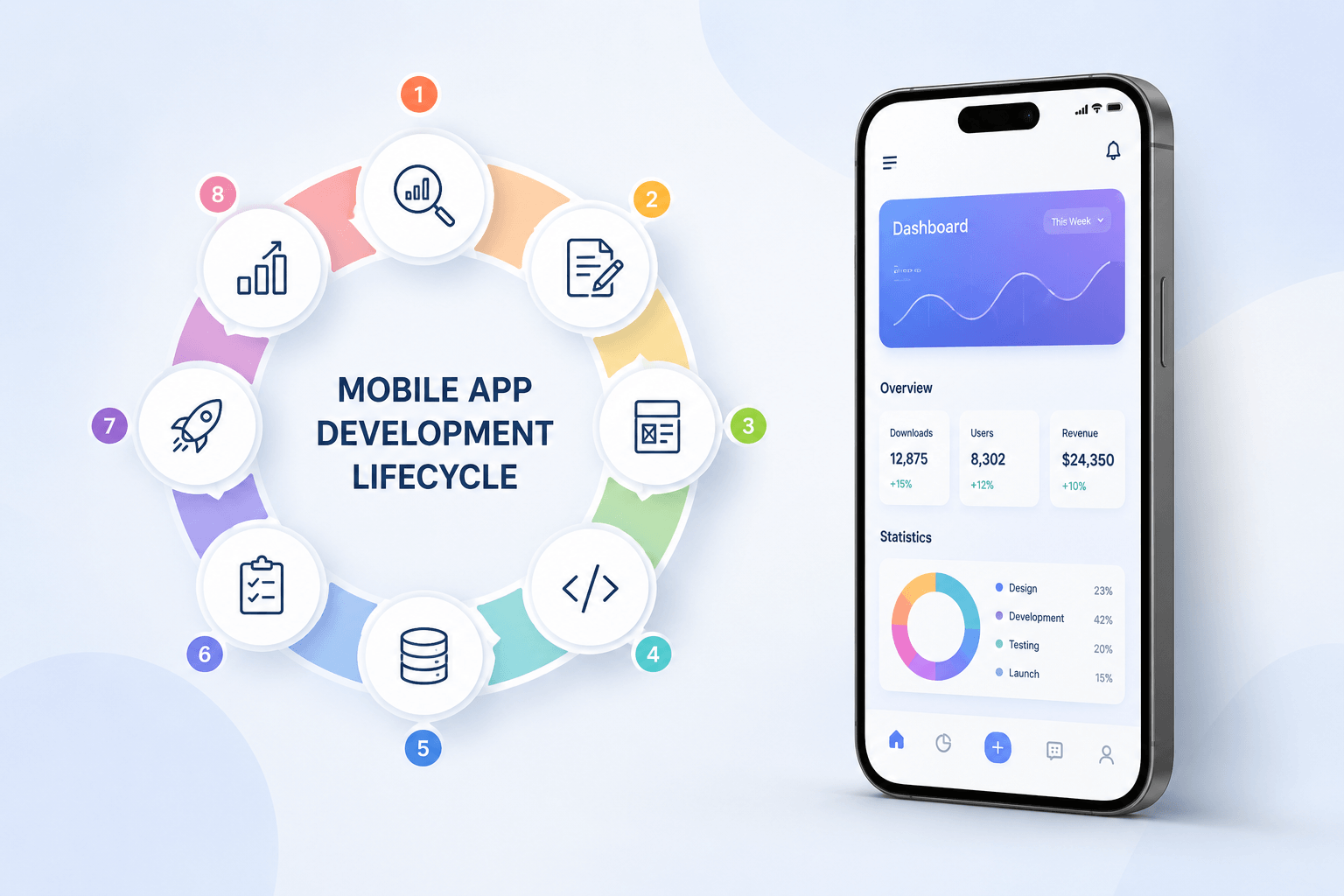
Mobile App Development Lifecycle: Complete 2026 Guide (8 Stages)
Book your consultation now
Related Post