
How Do I Choose the Right Mobile App Development Company?
Quick Answer To choose the right mobile app development company, check their portfolio and case studies, verify hands-on expertise in your required tech stack (Android, iOS, Flutter, or React Native), read client reviews, confirm transparent pricing and NDA protection, and ensure they offer post-launch support. A company with 15+ years of experience, 500+ delivered apps, and end-to-end services (strategy, design, development, testing, and App Store/Play Store publishing) is generally a safer, more reliable choice. |
Choosing a mobile app development company is one of the most important decisions you’ll make before building your product. The right partner turns a rough idea into a functioning app that users actually keep on their phones. The wrong one can burn your budget, miss your launch window, and leave you with buggy, unscalable code. This guide breaks down exactly what to check before you sign a contract, so you can compare companies with confidence instead of guesswork.
1. Start With Your Own Requirements, Not Their Sales Pitch
Before you evaluate any company, get clear on what you actually need. A company that’s excellent for a simple MVP may not be the right fit for a complex, AI-driven marketplace app, and vice versa.
- What platform do you need — Android, iOS, or both?
- Do you need a native app or a cross-platform solution (Flutter, React Native)?
- Is this a simple MVP, a mid-complexity app, or an enterprise-grade platform?
- What’s your realistic budget range and timeline?
Having these answers ready lets you ask sharper questions and instantly filter out companies that don’t specialize in what you need. A clear mobile app strategy at this stage saves both time and money later.
2. Review Their Portfolio and Case Studies — Not Just Screenshots
Anyone can show polished mockups. What matters is proof of apps that are actually live, being used, and rated by real customers.
- Ask for direct Play Store / App Store links, not just images.
- Check the app’s rating, review count, and last update date.
- Ask which specific modules they built and which technologies were used.
For example, a detailed portfolio or case studies page that names real clients, real apps, and real outcomes — such as a fintech cross-border payment app or a field workforce tracking platform — tells you far more than a generic “we build all kinds of apps” claim.
3. Match Their Tech Stack to Your Project
A capable company should be able to clearly explain which technology fits your goals and why — not push whatever they happen to know.
- Native Android development (Kotlin/Java) for Android-first products
- Native iOS development (Swift, SwiftUI) for premium iPhone/iPad experiences
- Cross-platform development (Flutter, React Native) when speed and budget matter more than 100% native performance
If a company can’t explain the trade-offs between these options in plain language, that’s a sign to keep looking.
4. Check Experience, Ratings, and Client Reviews
Years in business and number of apps delivered are strong indicators of reliability — but only when backed by verifiable reviews.
- Look for companies with a long, consistent track record rather than a newly registered agency.
- Read reviews that mention communication, timelines, and post-launch behavior — not just “great app.”
- A strong signal is direct client testimonials with names, roles, and locations.
As a benchmark, established freelance developers with 20+ years of experience and 500+ delivered apps across fintech, healthcare, SaaS, and e-commerce typically bring fewer surprises to a project than newer teams still building their first case studies.
5. Understand Their Pricing Structure — and Question Anything Too Cheap
Transparent companies tie their pricing to scope, features, and platform rather than giving one flat number for every project. As a general industry benchmark:
- Basic apps: roughly $25,000 and up
- Mid-complexity apps: roughly $25,000–$75,000
- Advanced, enterprise-grade apps: $75,000–$100,000+
If a quote is dramatically lower than these ranges with no explanation of what’s excluded, treat it as a red flag rather than a bargain — it usually means cut corners in testing, security, or scalability.
6. Confirm NDA, Contracts, and Communication Process
Before any development starts, a trustworthy company should:
- Sign a Non-Disclosure Agreement (NDA) to protect your idea and source code.
- Give you a written proposal outlining scope, milestones, and cost.
- Assign a clear point of contact and a regular update schedule (daily or weekly).
You should never have to chase a developer for a status update. If you want to see how this process typically works, most established teams outline it during a free consultation call before any commitment is made.
7. Ask About Timelines Realistically
Development timelines vary by complexity, and a company that gives you an honest range — rather than an unrealistically fast promise — is one worth trusting.
- Basic apps: 2–4 weeks
- Medium-complexity apps: 4–8 weeks
- Advanced apps with multiple integrations: 8–12+ weeks
8. Don’t Forget Post-Launch Support and App Store Publishing
Launching the app isn’t the finish line — it’s the start of its real life. Confirm the company offers ongoing support and maintenance, handles Play Store and App Store submissions, and can resolve rejection issues without extra back-and-forth. Many first-time app owners underestimate how much post-launch work — bug fixes, OS updates, new feature requests — a good app actually needs.
At-a-Glance Comparison: What to Look For vs. What to Avoid
Evaluation Factor | What a Reliable Company Shows | Red Flag to Avoid |
Portfolio | Live apps on Play Store / App Store with real user ratings | Only mockups or screenshots, no live links |
Case Studies | Documented modules, tech stack, and outcomes per project | Vague “we build all kinds of apps” claims |
Tech Expertise | Named expertise in Android (Kotlin), iOS (Swift), Flutter, React Native | One generic “full stack” answer for every project |
Communication | Fixed points of contact, regular progress updates | Slow replies, unclear ownership of your project |
Pricing | Transparent cost ranges tied to scope and features | Lowest quote with no breakdown of deliverables |
Contracts | NDA and clear agreement before development starts | Reluctance to sign an NDA or contract |
Post-Launch Support | Maintenance, bug fixes, and updates after launch | No mention of support once the app is delivered |
Why Founders Choose Mr Mobile App Developer
With 22+ years of experience and 550+ apps delivered across fintech, healthcare, SaaS, e-commerce, and Web3, Mr Mobile App Developer offers end-to-end services covering strategy, UI/UX, development, testing, and App Store/Play Store publishing — backed by an NDA on every project and an A+ client rating. Whether you need a freelance mobile app developer for a lean MVP or a full team for an enterprise platform, the same evaluation checklist above applies — proof of past work, clear tech expertise, transparent pricing, and real post-launch support.
Frequently Asked Questions
How do I verify if a mobile app development company is genuine?
Check for live apps on the Play Store or App Store with real ratings, ask for direct client references, confirm they sign an NDA, and look for a physical business address and consistent online presence (LinkedIn, reviews, case studies).
What questions should I ask before hiring an app developer?
Ask about their experience with your required tech stack, request 2–3 relevant case studies, confirm the pricing breakdown, ask who will be your single point of contact, and clarify what post-launch support is included.
Is it better to hire a freelance developer or an agency?
An experienced freelance developer with a strong, verifiable portfolio can often deliver the same quality as a larger agency at a lower cost and with more direct communication, while a large agency may suit projects needing a bigger team across multiple specializations at once.
How much does it cost to build a mobile app?
Costs generally range from about $25,000 for a basic app to $100,000+ for an advanced, feature-rich app, depending on platform, design complexity, backend architecture, and integrations.
How long does it take to build an app?
Basic apps typically take 2–4 weeks, medium-complexity apps take 4–8 weeks, and advanced apps with multiple integrations can take 8–12+ weeks.
Ready to evaluate a partner for your own project? Schedule a free consultation with Mr Mobile App Developer to discuss your app idea and get a transparent scope and cost estimate.
Get best mobile app development services
Develop your business app
Conclusion
Choosing the right mobile app development company starts with evaluating experience, technical expertise, communication, transparent pricing, and post-launch support. Taking the time to compare your options carefully will help you choose a reliable partner and build a high-quality, scalable mobile app.
If you’re looking for an experienced development partner, Mr Mobile App Developer brings 22+ years of experience, 550+ successfully delivered mobile applications, and end-to-end expertise in Android, iOS, Flutter, React Native, UI/UX design, backend development, testing, and App Store & Google Play deployment. Contact us today for a free consultation to discuss your app idea, choose the right technology stack, and receive a transparent project scope and cost estimate before you begin.
Quality Service For You
We deliver unique and blended experiences to our customers across the globe. From idea to execution and launch, we do ALL.
Backend Development:
Table of Contents
Why Mobile Apps Fail After Launch: 15 Common Reasons and How to Prevent Them
How to Calculate ROI for Mobile App Development in 2026
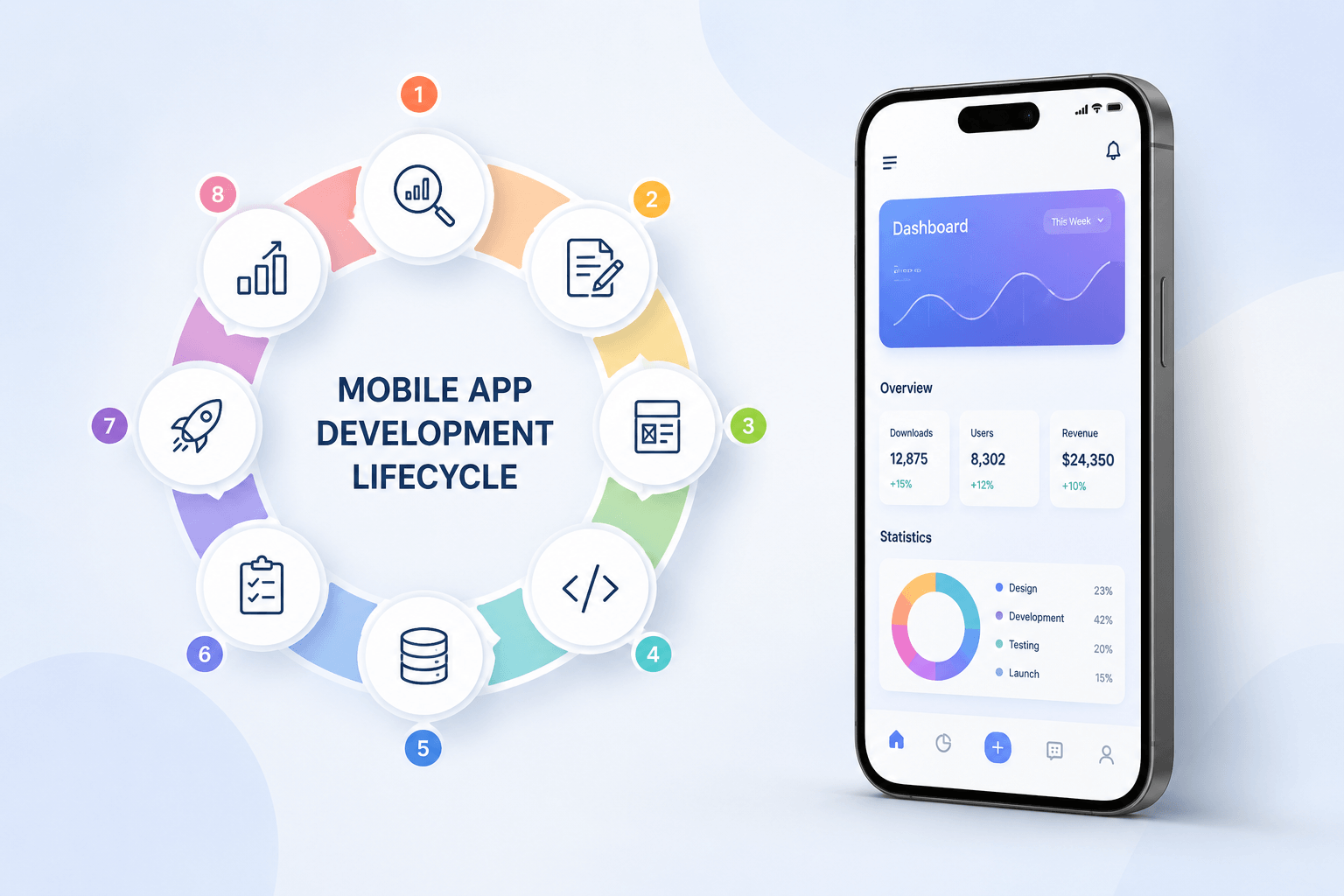
Mobile App Development Lifecycle: Complete 2026 Guide (8 Stages)
Book your consultation now
Related Post