
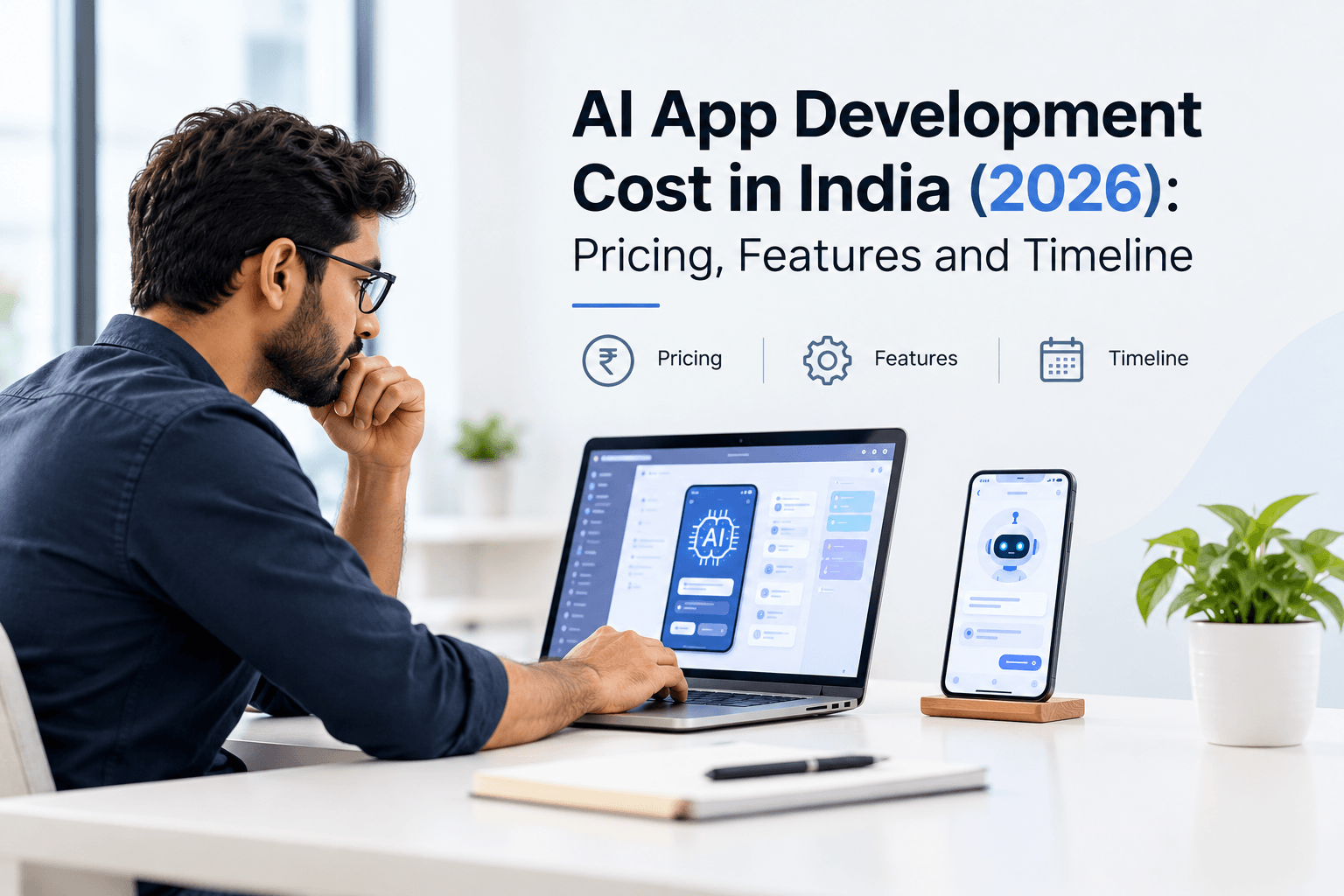
AI App Development Cost in India (2026): Pricing, Features and Timeline
Quick Answer: How Much Does AI App Development Cost in India?
AI app development in India can range from approximately ₹2 lakh for a limited prototype to ₹1 crore or more for a complex enterprise platform. These are indicative planning estimates, not fixed market rates or a development quotation.
Type of AI application | Estimated development cost | Approximate timeline |
Basic AI chatbot or FAQ assistant | ₹2 lakh–₹8 lakh | 2–6 weeks |
AI feature added to an existing app | ₹2 lakh–₹6 lakh | 3–6 weeks |
AI-powered mobile app MVP | ₹6 lakh–₹18 lakh | 8–16 weeks |
AI document assistant or knowledge platform | ₹8 lakh–₹25 lakh | 8–16 weeks |
AI recommendation or predictive analytics app | ₹6 lakh–₹25 lakh | 8–20 weeks |
AI agent with business integrations | ₹12 lakh–₹35 lakh | 12–20 weeks |
Enterprise AI application | ₹40 lakh–₹1 crore+ | 4–12 months or longer |
Note: Costs and timelines are illustrative ranges for initial budgeting in India. Project scope, data quality, integrations, security, team composition, and testing requirements can significantly change the final estimate. Some complex projects may fall outside these ranges.
For most startups, the practical starting point is to identify one valuable AI use case, build a minimum viable product (MVP), test it with real users, and expand only after validating its usefulness.
What Factors Affect AI App Development Cost?
Beyond AI-specific expenses, businesses should also consider platform selection, backend development, UI/UX design, and ongoing maintenance. Understanding the broader mobile app development cost in India can help you plan your overall development budget.
The cost of an AI application is determined by much more than the AI model itself. The surrounding software, data infrastructure, integrations, testing, and ongoing operations all contribute to the final budget.
1. Type and Complexity of the AI Application
The first cost factor is the problem your application needs to solve.
For example, a chatbot that answers predefined questions is simpler than an AI assistant that searches company documents, checks a customer account, retrieves information from multiple systems, and prepares an action for approval.
Common application types include:
- AI chatbots: Answer questions, provide support, and guide users.
- Generative AI applications: Generate text, images, summaries, or other content.
- Recommendation engines: Suggest products, services, or content based on user behavior.
- Predictive analytics applications: Analyze historical data to estimate future outcomes.
- Computer vision applications: Analyze images and videos for tasks such as inspection or recognition.
- AI agents: Use tools and connected systems to complete defined workflows.
- Enterprise AI platforms: Combine multiple AI capabilities with business systems, permissions, and monitoring.
As complexity increases, developers must handle more data, edge cases, integration logic, testing, and operational requirements.
2. AI Model Selection
Your application may use a third-party AI API, an open-source model, a fine-tuned model, or a custom-trained model.
Each option has different development and operating costs.
AI approach | Best suited for | Cost consideration |
Third-party AI API | Chatbots, summarization, content generation | Faster initial development, recurring usage charges |
Open-source AI model | Specialized workloads or greater deployment control | Hosting, infrastructure, optimization, and maintenance |
Fine-tuned model | Tasks requiring consistent specialized behavior | Dataset preparation, training, and evaluation |
Custom-trained model | Specific problems requiring a model built around specialized data | Substantial data, computing, research, and engineering investment |
For many startups, integrating an existing model API is the most practical starting point. It avoids the expense of training a model from scratch and helps teams validate their idea sooner.
Custom training should be considered when a clearly defined technical, performance, privacy, or economic requirement justifies the additional investment.
3. Data Collection and Preparation
AI applications are only as useful as their data and their ability to retrieve relevant information.
Depending on the project, developers may need to collect, clean, organize, label, or securely connect datasets. Documents may require optical character recognition (OCR), while a business knowledge assistant may need a searchable index of company policies, product information, and support documentation.
Data preparation can involve:
- Removing duplicate or outdated records.
- Correcting inconsistent formats.
- Labeling training or evaluation examples.
- Building data pipelines.
- Creating searchable document indexes.
- Establishing access permissions.
- Checking data quality and relevance.
If your business data is already organized and accessible, development may be simpler. If it is scattered across spreadsheets, PDFs, databases, and legacy systems, data preparation can become a significant part of the budget.
4. UI and UX Design
An AI application needs a user interface that makes its capabilities easy to understand and use.
A simple chatbot may require a conversation screen and a basic settings panel. A full AI business application might need dashboards, user accounts, file uploads, search filters, reports, subscription management, and an administrative interface.
The more screens, user roles, and workflows the application requires, the more time the design and development teams will need.
A good interface should also explain AI limitations, show useful error messages, and allow users to correct or review important outputs.
5. Third-Party Integrations
Integrations connect your AI application to the tools and data that make it useful.
Common examples include:
- Payment gateways and subscription systems.
- Customer relationship management (CRM) platforms.
- Enterprise resource planning (ERP) software.
- WhatsApp or other messaging services.
- Cloud storage and document management tools.
- Analytics platforms and business databases.
- Authentication and identity management systems.
Each integration introduces additional development, testing, and maintenance work. The final cost depends on API availability, documentation, authentication requirements, data formats, and the complexity of the workflow.
6. Security, Privacy, and Testing
An AI application handling customer records, business documents, financial information, or personal data requires careful security planning.
Depending on the use case, the project may need encryption, role-based permissions, audit logs, data-retention controls, secure API handling, and privacy reviews.
AI-specific testing is equally important. Developers should evaluate incorrect answers, unreliable outputs, prompt injection, unauthorized data access, and situations in which the application should refuse or escalate a request.
Skipping these activities may reduce the initial quotation but increase the risk of expensive problems after launch.
AI App Development Cost by Application Type
Understanding the type of application you want to build is one of the easiest ways to estimate a realistic budget.
1. AI Chatbot Development Cost
Estimated cost: ₹2 lakh–₹8 lakh
Typical timeline: 2–6 weeks
A basic AI chatbot can answer common customer questions, explain products or services, and direct users to relevant information.
The budget may cover a chat interface, model API integration, basic conversation management, and deployment.
Costs can increase when the chatbot needs to retrieve answers from private documents, support multiple languages, connect to a CRM, authenticate users, or transfer conversations to human agents.
For example, an online business that wants to answer product questions may need a relatively simple chatbot. A support assistant that checks order information and processes approved requests requires more integration and testing.
2. AI-Powered Mobile App MVP Cost
Estimated cost: ₹6 lakh–₹18 lakh
Typical timeline: 8–16 weeks
An AI-powered mobile app MVP is a limited but usable version of a product that helps a business validate its core idea.
Possible features include user registration, an AI assistant, personalized results, a backend database, basic analytics, and one or two essential integrations.
Examples include an AI study assistant, a content planning app, a product recommendation app, or a document summarization tool.
The estimate depends on whether the app is built for Android, iOS, or both, and whether it requires a separate web dashboard or complex backend workflows.
Starting with a focused MVP is often more cost-effective than building every planned feature before confirming customer demand.
3. AI Document Assistant or Knowledge Base Cost
Estimated cost: ₹8 lakh–₹25 lakh
Typical timeline: 8–16 weeks
A document assistant allows users to ask questions about PDFs, reports, manuals, contracts, policies, or other business documents.
Many such systems use retrieval-augmented generation (RAG). Instead of relying only on a model’s existing knowledge, the application retrieves relevant information from a designated data source and uses it to formulate an answer.
Depending on the requirements, development may include document processing, search indexing, source references, user permissions, and an administrative dashboard.
A reliable knowledge assistant needs more than a chat interface. It must retrieve relevant information, handle missing answers appropriately, and prevent users from accessing documents they are not authorized to view.
4. AI Recommendation Engine Cost
Estimated cost: ₹6 lakh–₹25 lakh
Typical timeline: 8–20 weeks
Recommendation engines suggest products, courses, services, videos, or other items based on user preferences and available data.
The cost depends on the volume and quality of historical data, the recommendation method, integration requirements, and how success will be measured.
A basic recommendation feature can use existing business rules or a hosted model. A sophisticated system may need behavioral analytics, ranking algorithms, experimentation, and continuous performance evaluation.
Businesses should define the intended outcome before choosing the technology. Improving product discovery, increasing relevant clicks, and reducing search time may require different approaches.
5. AI Agent Development Cost
Estimated cost: ₹12 lakh–₹35 lakh
Typical timeline: 12–20 weeks
AI agents can use connected tools to complete defined tasks rather than simply generate responses.
For example, a business operations agent might retrieve an invoice, compare it with purchase-order data, flag a discrepancy, and prepare an approval request for a human reviewer.
The development work can include tool integrations, workflow orchestration, permissions, validation rules, logging, and recovery mechanisms.
The most important distinction is whether the agent only recommends an action or is authorized to execute it. Actions involving money, personal data, account changes, or business-critical operations require stronger safeguards and approval controls.
6. Enterprise AI Application Cost
Estimated cost: ₹40 lakh–₹1 crore or more
Typical timeline: 4–12 months or longer
Enterprise applications may combine multiple AI capabilities with internal databases, existing business software, complex permissions, and large-scale infrastructure.
They may also require high availability, audit trails, advanced monitoring, data governance, deployment restrictions, and formal security reviews.
These projects are difficult to price accurately without a discovery phase because the number of integrations, data sources, user roles, and operational requirements can vary substantially.
A detailed scope, technical assessment, and phased implementation plan help establish a more reliable estimate.
What Features Should Your AI App Include?
Not every AI application needs every available feature. The right feature set depends on the problem, target audience, and business model.
Feature | Purpose | Priority |
User registration and authentication | Secure access to the application | Essential for most multi-user products |
AI model integration | Powers the core AI capability | Essential for AI-driven functionality |
Database and backend | Stores application data and manages workflows | Based on product requirements |
API integrations | Connects external tools and services | Required when external systems are involved |
Error handling and fallback | Manages outages, timeouts, and failed responses | Essential for production reliability |
Analytics and usage tracking | Measures adoption, performance, and cost | Strongly recommended |
Admin dashboard | Manages users, content, and application settings | Depends on operational needs |
Security and permissions | Protects users and sensitive information | Essential where applicable |
AI evaluation and monitoring | Tracks output quality and regressions | Strongly recommended for production |
Payments and subscriptions | Supports paid access and monetization | Required for relevant business models |
A useful starting point is to divide features into three groups: must-have features for launch, improvements that can follow after validation, and advanced capabilities that should be introduced only when there is a clear business case.
This approach helps prevent unnecessary development expenses.
AI App Development Timeline: From Idea to Launch
The development timeline depends on the application’s scope, the team’s experience, data readiness, and the complexity of integrations.
A typical process includes the following stages.
Stage 1: Discovery and Requirement Planning
Estimated duration: 1–2 weeks
The team identifies the target audience, business problem, expected outcomes, core workflows, technical constraints, and success metrics.
This stage should establish what the AI application must do and how its performance will be evaluated.
Stage 2: UI/UX Design and Technical Architecture
Estimated duration: 1–3 weeks
The team plans the user experience, system architecture, database structure, model integration approach, and security requirements.
A prototype may be tested with potential users before development moves forward.
Stage 3: AI Integration and Application Development
Estimated duration: 3–8 weeks or longer
Developers build the core application, integrate the chosen AI model, connect data sources, and implement the main workflows.
This stage may take longer when the project requires custom algorithms, complex document processing, or multiple third-party systems.
Stage 4: Testing and AI Evaluation
Estimated duration: 1–3 weeks
Testing covers functionality, usability, security, performance, and AI output quality.
The team should evaluate representative real-world inputs, incorrect or incomplete responses, unusual user behavior, and failures in external services.
Stage 5: Deployment and Launch
Estimated duration: 1–2 weeks
The application is deployed, monitoring is configured, and the team verifies that the production environment is ready.
Mobile apps may also require app store review, which can introduce additional waiting time.
These stages may overlap. A simple prototype can be delivered much sooner than a production-ready application, and an enterprise platform may require several additional development and testing cycles.
Hidden Costs of AI App Development
The initial development quotation is only part of the total cost of ownership. AI applications can generate recurring expenses that should be included in the budget from the beginning.
Regular maintenance helps keep an app secure, compatible, and reliable after launch. Learn more about our mobile app support and maintenance services to understand the support an app may need over time.
1. AI Model API Charges
Many AI providers charge according to usage, such as input and output tokens, processed images, audio, or other model-specific units.
Costs depend on the model, the amount of information processed, response length, and the number of requests.
For example, a chatbot that handles a few short queries per user may cost much less to operate than an assistant that repeatedly analyzes lengthy documents.
2. Cloud Hosting and Infrastructure
Your application may require servers, databases, storage, background jobs, monitoring tools, and other cloud services.
Applications that run models on their own infrastructure may also require specialized computing resources.
3. Maintenance and Updates
Software libraries, operating systems, AI APIs, and third-party services change over time. Maintenance may include bug fixes, compatibility updates, security patches, and improvements to application performance.
AI applications also need periodic checks to ensure that changes in models or source data do not reduce answer quality.
4. Data Storage and Processing
Applications that store documents, images, conversation histories, or large datasets may incur storage, indexing, and processing expenses.
These costs depend on the volume of data, retention requirements, and frequency of updates.
5. Monitoring and Quality Evaluation
Production systems need monitoring for failures, latency, unexpected costs, and poor-quality outputs.
For applications that make important business decisions, human review and additional validation may be necessary.
How Much Should You Budget Monthly?
For an early-stage application, you might begin by evaluating a planning allowance of ₹10,000–₹50,000 per month for modest infrastructure and AI usage. This is a budgeting example, not a standard price or guarantee.
Actual expenses can be lower for a lightweight application or substantially higher for a busy product, expensive models, large documents, or dedicated infrastructure. Maintenance, support, and additional development may need a separate budget.
The most reliable method is to estimate the cost per active user or per completed task using realistic usage assumptions, then test that estimate before launch.
How to Reduce AI App Development Cost Without Sacrificing Quality
You do not need to build an expensive, feature-heavy application to validate an AI business idea. A focused scope and a sensible technical approach can help control the initial investment.
Start With One High-Value Use Case
Identify the problem that matters most to your target users.
Instead of building a broad AI business assistant immediately, start with a specific task such as answering product questions, summarizing documents, or categorizing support requests.
Use Existing AI Models Where Appropriate
Evaluate hosted model APIs before considering custom model training. Existing models can support many common tasks without the time and expense of developing a model from scratch.
Choose a different approach only when testing reveals a clear need.
Build an MVP Before a Full Product
Prioritize the minimum set of features needed to deliver value to early users.
An MVP can help validate demand, reveal technical limitations, and identify which features deserve further investment.
Prepare Your Data Early
Organize documents, review data quality, and clarify permissions before development begins.
Doing this early can reduce rework and help the development team estimate the project more accurately.
Control AI Usage
Use suitable models for different tasks, limit unnecessary context, cache reusable results where appropriate, and monitor usage.
These measures can reduce recurring expenses without automatically compromising the user experience.
Request a Detailed Development Estimate
A useful quotation should identify the included features, assumptions, integrations, testing activities, deployment requirements, exclusions, and ongoing costs.
Compare proposals based on what will actually be delivered rather than choosing a vendor solely because the initial price is lower.
How to Choose the Right AI App Development Company
Selecting a development partner affects the application’s reliability, delivery timeline, security, and long-term operating cost.
Before making a decision, ask these questions:
- Has the team built applications with comparable technical requirements?
- Can it explain why a particular AI model or architecture is appropriate?
- How will the team evaluate accuracy and handle unreliable AI outputs?
- What data security and access controls will be implemented?
- Which third-party API, hosting, and maintenance costs are excluded from the quotation?
- Will you receive the agreed source code, documentation, and deployment access?
- How will the project be divided into milestones, and what are the acceptance criteria?
- What support is available after launch?
A capable development partner should explain trade-offs clearly, identify project risks, and provide a realistic scope rather than promising that every AI feature can be built cheaply or delivered immediately.
Businesses planning a new application can explore Mr Mobile App Developer to learn more about its mobile app development services and discuss their project requirements.
Is AI App Development Worth the Investment in 2026?
AI app development can be worthwhile when the application solves a real problem, improves an existing process, or delivers value that customers are willing to pay for.
However, AI adoption alone does not guarantee a profitable product. Businesses should estimate development costs, recurring expenses, expected revenue, operational savings, and the time required to recover their investment.
For example, an AI support assistant may reduce the time employees spend answering repetitive questions. An AI recommendation feature may help users discover relevant products. A document assistant may reduce manual information retrieval.
In each case, the business should measure the outcome rather than assume that adding AI will automatically improve performance.
A sensible investment process starts with a defined problem, a measurable success criterion, and a limited pilot. If the results justify further investment, the application can be expanded in stages.
Frequently Asked Questions About AI App Development Cost in India
How much does it cost to build an AI app in India in 2026?
An AI application may cost around ₹2 lakh–₹8 lakh for a basic chatbot, ₹6 lakh–₹18 lakh for a focused AI mobile app MVP, and ₹40 lakh or more for a complex enterprise application. These are indicative estimates; actual pricing depends on features, data, integrations, security, and infrastructure.
Can I build an AI app with a budget of ₹5 lakh?
Yes, a limited prototype, a basic chatbot, or a narrowly scoped AI feature may fit within ₹5 lakh. The scope may need to exclude advanced integrations, extensive custom model development, complex administration features, and high-scale infrastructure.
How long does it take to develop an AI app?
A basic prototype may take a few weeks, while a production-ready AI MVP can require approximately 8–16 weeks. Enterprise applications may take several months or longer. The timeline depends on requirements, data readiness, integrations, testing, and deployment needs.
Is AI app development more expensive than regular app development?
It can be, but not in every case. The cost depends on whether the application needs AI integration, specialized data processing, model evaluation, or custom infrastructure. A simple AI feature using a hosted API may be relatively affordable, while a custom AI platform can require substantial additional engineering.
Do I need to train my own AI model?
Usually not for an initial product. Many applications can use existing models through APIs or open-source solutions. Custom training or fine-tuning may be appropriate when a specific performance, data, or deployment requirement cannot be met adequately by the available options.
What are the ongoing costs of an AI application?
Recurring expenses may include AI API usage, cloud hosting, storage, data processing, monitoring, maintenance, and technical support. The total depends on how often the application is used, the complexity of each request, and the infrastructure selected.
Can I add AI features to an existing mobile app?
Yes. Common additions include AI chat, intelligent search, document summarization, recommendations, content generation, and automated support workflows. The cost depends on the existing app architecture, data access, integration requirements, and security needs.
What is the cheapest way to develop an AI app?
Start with one well-defined use case, use an appropriate existing model, prepare the required data, and develop only the essential features. Validate the product with a small group of users before investing in advanced capabilities or large-scale infrastructure.
How can I calculate the ROI of an AI application?
Compare the measurable benefits with the total cost of development and operation. Benefits might include reduced manual work, additional revenue, faster processing, or improved customer retention. Include recurring AI usage, hosting, maintenance, and support when calculating the payback period.
Get best mobile app development services
Develop your business app
Conclusion
The cost of AI app development in India in 2026 depends primarily on the problem you are solving, the features you need, the quality of your data, and the reliability your users expect.
A basic chatbot may require only a modest initial investment, while an AI-powered product with complex workflows, custom data pipelines, and enterprise integrations needs a more substantial budget.
The best way to control costs is to define your requirements clearly, choose the simplest suitable architecture, validate the idea with an MVP, and plan for ongoing operations from the start.
If you are considering an AI-powered mobile application, visit Mr Mobile App Developer to explore mobile app development services and discuss the scope, budget, and timeline for your project.
Build around a real user problem, measure the results, and scale your AI application when the evidence supports the investment.
Quality Service For You
We deliver unique and blended experiences to our customers across the globe. From idea to execution and launch, we do ALL.
Backend Development:
Table of Contents
Why Mobile Apps Fail After Launch: 15 Common Reasons and How to Prevent Them
How to Calculate ROI for Mobile App Development in 2026
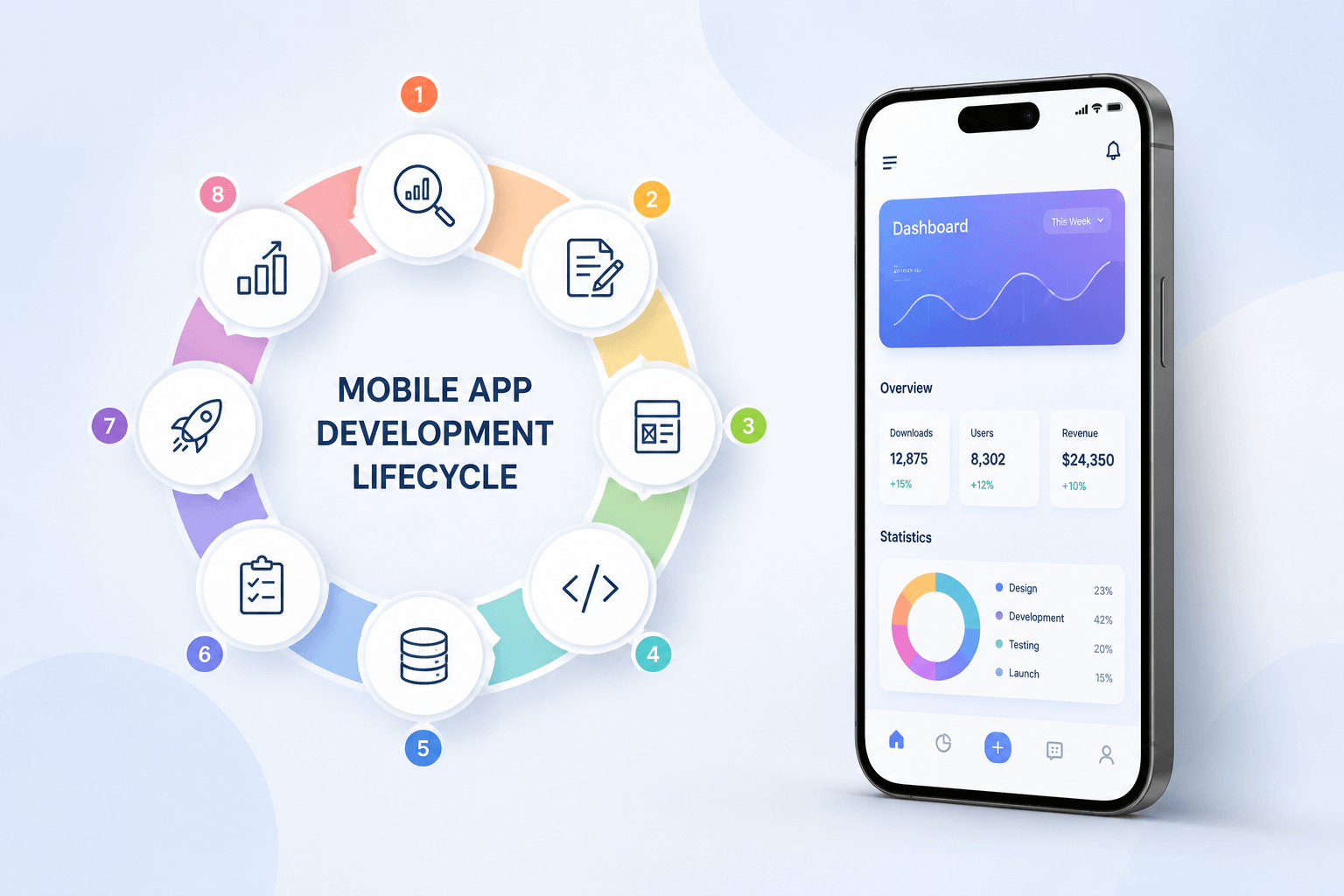
Mobile App Development Lifecycle: Complete 2026 Guide (8 Stages)

Book your consultation now
Related Post