How to Monetize a Mobile App: Complete Guide (2026)
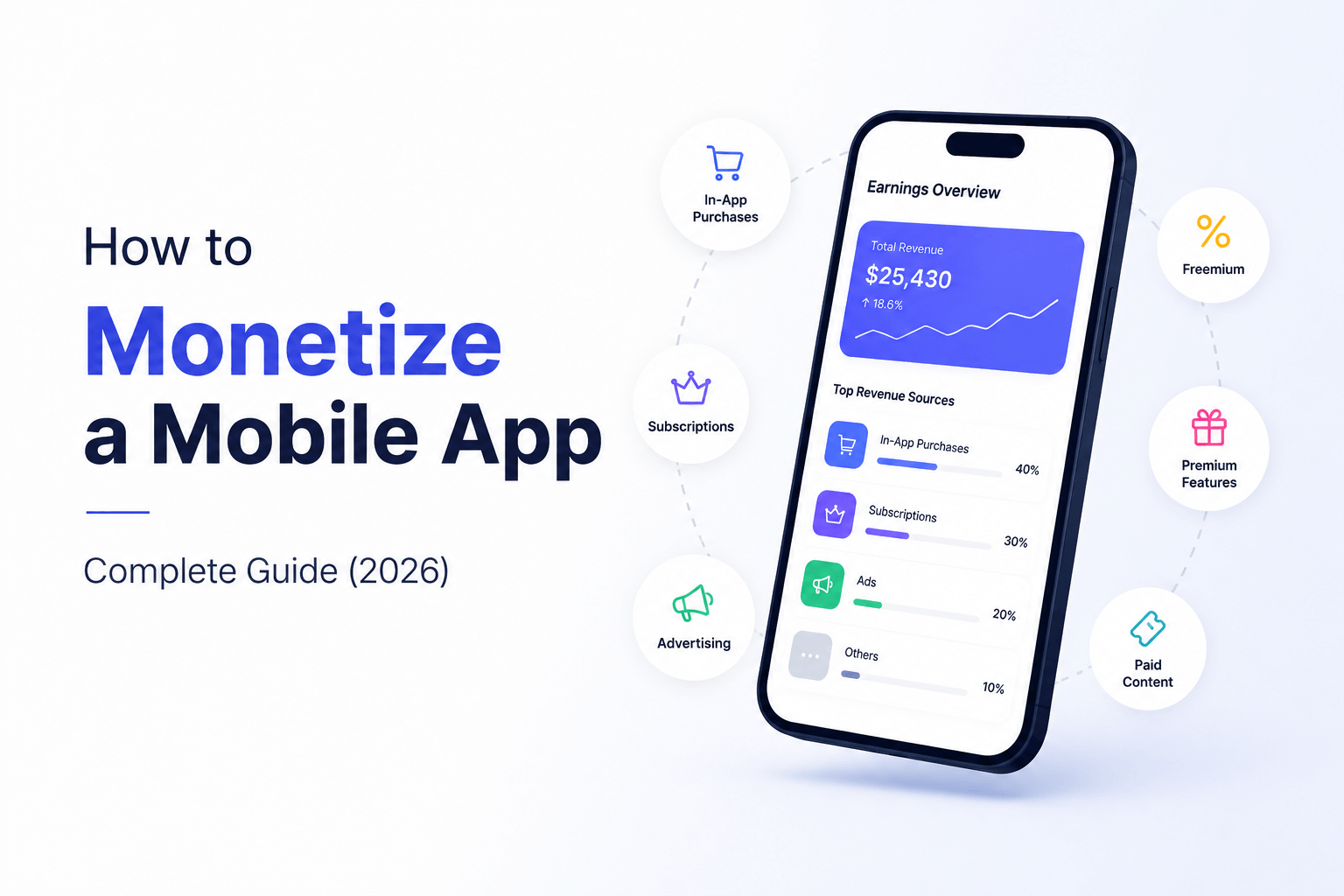
Quick Answer: There are 9 proven ways to monetize a mobile app: in-app advertising, in-app purchases, subscriptions, the freemium model, one-time paid downloads, transaction/commission fees, sponsorships and affiliate marketing, physical goods/services upsell, and data-driven monetization. Most successful apps in 2026 combine two or three of these rather than relying on one. The right mix depends on your app category, how often users open the app, and whether your value is delivered once or repeatedly.
Building the app is only half the business. The other half is deciding how it earns money — and that decision needs to happen before development starts, not after launch, because it shapes your onboarding flow, your feature gating, and even your backend architecture (payment gateway integration, subscription billing, ad SDKs).
This guide breaks down every major monetization model with real revenue benchmarks, shows you how to pick the right one for your app category, and flags the mistakes that quietly kill revenue in otherwise well-built apps.
Why Your Monetization Model Has to Be a Day-One Decision
Retrofitting monetization into an app that wasn’t built for it is expensive. A subscription paywall needs receipt validation, trial logic, and renewal handling baked into the backend. In-app ads need SDK integration and ad-unit placement that doesn’t wreck your UX. Transaction fees need a payment gateway and escrow logic from day one if you’re running a marketplace.
If you’re still validating your idea or scoping your build, decide your monetization model alongside your app business plan and your MVP feature list — not after your first release.
The 9 Mobile App Monetization Models (With Real Benchmarks)
1. In-App Advertising
You show ads (banner, interstitial, native, or rewarded video) inside a free app and earn revenue per impression or click through an ad network like Google AdMob or Meta Audience Network.
Best for: High-usage, free-to-download apps — games, utilities, content and news apps
Revenue potential: Average eCPM (cost per 1,000 ad impressions) runs roughly $2–8 depending on ad format and geography, with iOS traffic typically earning more than Android for the same impressions. An app with 100,000 monthly active users can realistically generate anywhere from a few thousand to well over $50,000 a month from ads, depending on category, geography, and ad-format mix.
User friction: Highest of any model if overdone — too many interstitials tank retention
Best practice: Rewarded video ads (user opts in for a reward) convert better and annoy users less than forced interstitials
2. In-App Purchases (IAP)
Users buy virtual goods, extra features, or consumable items inside the app — a one-time transaction, not a recurring charge.
Best for: Games (skins, power-ups, extra lives), productivity apps (premium templates), social apps (virtual gifts)
Revenue potential: Global IAP revenue is the single largest slice of app monetization — well over $150 billion a year and still growing — because it captures your highest-spending “whale” users without forcing everyone into a subscription
User friction: Low, since it’s optional and non-recurring
Watch out for: Apple and Google both take a platform commission on digital-goods IAPs (typically 15–30% depending on revenue tier), so price accordingly
3. Subscription Model
Users pay a recurring fee (weekly, monthly, or annual) for continued access to content or features.
Best for: Apps that deliver ongoing value — fitness, education, streaming, SaaS-style productivity tools, dating apps
Revenue potential: Subscription apps consistently out-earn ad-only apps on a per-user basis — often by 4x or more — and weekly subscription plans in particular have grown sharply as a share of total app revenue over the past two years, especially in fitness and utility categories
User friction: Highest upfront commitment — needs a strong free trial or freemium on-ramp to convert
Best practice: Most trial-to-paid conversion happens in the first session. Your onboarding screen is effectively your paywall — invest in it accordingly, and A/B test pricing before you scale spend
4. Freemium Model
The app is free with a core feature set; advanced features, storage, or usage limits sit behind a paywall.
Best for: Utility and productivity apps, cloud storage, editing tools — anything where “try before you commit” reduces buying friction
Revenue potential: Lower conversion rate (typically low single digits to low teens percent of free users), but the free tier drives the download volume and word-of-mouth that makes the paid tier worth having
User friction: Low to enter, but the free tier has to be genuinely useful or you get downloads with no upgrades
5. One-Time Paid Download
Users pay upfront before they can install the app — no free tier at all.
Best for: Niche professional tools, specialized calculators, premium single-use utilities with a clearly defined value prop
Revenue potential: Smallest share of the market — only a small minority of apps use pure paid-download pricing globally, because it kills discovery in an app-store environment built around free installs
User friction: Highest at the download stage — you’re asking for money before the user has tried anything
When it still works: Apps with an established brand, a professional/B2B audience, or no viable free-tier equivalent (some pro camera or CAD-style tools)
6. Transaction & Commission Fees
You take a percentage or flat fee on every transaction that happens through the app — the model behind every marketplace, on-demand, and booking app.
Best for: Marketplaces, food/grocery delivery, ride-hailing, real estate listing, service-booking apps
Revenue potential: Scales directly with transaction volume, not user count — a marketplace with fewer but higher-value transactions can outperform an ad-supported app with 10x the users
User friction: None on the buyer side if the fee is absorbed by the seller/vendor
Build requirement: Needs a payment gateway with split-payment or escrow support from day one — this is a backend decision, not a “we’ll add it later” one
7. Sponsorship & Affiliate Marketing
Brands pay to be featured inside your app, or you earn a commission when users buy a product/service you recommended.
Best for: Content, lifestyle, fitness, and niche community apps with an engaged, well-defined audience
Revenue potential: Smaller than ads or IAP in aggregate, but a small share of apps using affiliate links generate a disproportionately large share of their total revenue from it — a high-leverage secondary channel, not usually a primary one
User friction: Low if recommendations are relevant; high if it reads as spam
8. Physical Goods & Service Upsell
The app itself is free (or low-cost) and functions as a funnel into a physical product or offline service — think fitness apps selling supplements, or gear/equipment upsells.
Best for: Apps tied to an existing product or service business, where the app’s job is retention and upsell rather than being the revenue source itself
Revenue potential: Depends entirely on the underlying product margin, not app metrics
Best practice: Track this separately from in-app revenue — it’s a business-model decision, not a technical one
9. Data-Driven Monetization
Aggregated, anonymized usage data is licensed to third parties for market research or analytics.
Best for: Apps with genuinely unique behavioral or usage data at scale
Reality check: This model carries serious privacy, compliance, and App Store/Play Store policy risk (and India’s DPDP Act adds another layer of obligation). It’s rarely a primary model for a new app and should only be considered with dedicated legal review — most apps are better off ignoring this one entirely.
Monetization Models Compared
Model | Best For | Revenue Predictability | User Friction | Backend Complexity |
In-app ads | High-usage free apps | Low–Medium | High if overdone | Low |
In-app purchases | Games, social, productivity | Medium | Low | Medium |
Subscription | Fitness, education, SaaS-style | High | High (needs trial) | High |
Freemium | Utility, productivity, storage | Medium | Low | Medium |
Paid download | Niche/pro tools | Low (volume) | Highest | Low |
Transaction fees | Marketplace, on-demand | High (scales w/ GMV) | None (buyer side) | High |
Sponsorship/affiliate | Content, lifestyle, niche | Low–Medium | Low | Low |
Physical/service upsell | Product-tied apps | Depends on product | Low | Medium |
How to Choose the Right Model for Your App
Match your model to your app category and usage pattern rather than copying whatever a competitor does:
- Gaming apps → In-app purchases first (skins, power-ups, lives), layered with rewarded video ads for free players
- Social & content apps → Ads plus a premium ad-free/feature tier (freemium), with sponsorship as a secondary channel once you have an engaged audience
- Utility & productivity apps → Freemium with a subscription upgrade for advanced features or higher usage limits
- Fitness, education, streaming → Subscription-first, with a free trial or limited freemium tier to reduce signup friction
- Marketplace, on-demand, delivery, real estate → Transaction/commission fees, since revenue needs to scale with GMV, not just downloads
- Fintech apps → Transaction fees plus a premium subscription tier for advanced tools (budgeting, analytics, priority support)
- Niche professional/B2B tools → One-time paid download or a straightforward subscription, since your audience already expects to pay for software
Most apps that scale well end up layering two models — for example, freemium plus ads for free-tier users, or transaction fees plus a premium subscription for power sellers.
Monetization Considerations for the Indian Market
If you’re building primarily for Indian users, a few local factors change the calculus:
- Payment rails: UPI (via Razorpay, Cashfree, or PayU) converts far better for one-time payments and subscriptions than card-only checkout — Indian users default to UPI first
- Price sensitivity: Weekly/monthly subscription pricing that works in the US or EU often needs a lower, India-specific price point to convert — don’t just convert currency 1:1
- Ad eCPMs: Ad revenue per impression is typically lower in the Indian market than in the US or Western Europe, so apps targeting Indian users usually need a larger user base or a secondary monetization layer (IAP or subscription) to hit meaningful revenue
- GST on digital goods: Factor GST into your IAP/subscription pricing structure — this is a compliance step, not optional
Common Mistakes That Kill App Monetization
- Adding monetization as an afterthought — bolting ads or a paywall onto a finished app usually means retrofitting your backend and your UX at the same time, which is more expensive than planning for it upfront
- Over-relying on ads alone — ad-only apps consistently earn less per user than apps with a subscription or IAP layer, and heavy ad frequency actively hurts retention
- Pricing a subscription without testing — the highest-performing subscription apps run dozens of pricing and paywall experiments; teams that price once and never test leave significant revenue on the table
- Ignoring Day 0 vs. long-term LTV trade-offs — optimizing purely for immediate conversion (cheap trial, aggressive discount) often produces worse 12-month revenue than a slightly harder paywall that filters for genuinely interested users
- Copying a competitor’s model without checking fit — a marketplace copying a SaaS subscription model, or a utility app copying a gaming IAP model, usually underperforms because the usage pattern doesn’t match the model
- Skipping platform commission math — forgetting that Apple/Google take a cut of digital-goods IAP and subscription revenue, which changes your real margin
How to Actually Implement Monetization: Step by Step
- Lock your model during planning, not after launch — decide alongside your app requirements document
- Choose your infrastructure early — ad SDK (AdMob, etc.), payment gateway (Razorpay/Stripe), or subscription billing (RevenueCat, or native App Store/Play Billing) — this affects your architecture, not just your UI
- Build the free-to-paid path into your MVP, not as a v2 feature — even a simple paywall screen needs to exist from day one to gather conversion data early
- Set a realistic free-tier limit that’s generous enough to demonstrate value but narrow enough to create a genuine upgrade reason
- Instrument analytics before you launch — you can’t optimize a paywall or ad placement you’re not measuring
- Test pricing regionally — especially important if you’re serving both Indian and international users from one app
- Review platform policies before submission — Apple and Google have specific rules on subscription disclosure, trial terms, and ad content that can cause app store rejection if missed
Frequently Asked Questions
How can I monetize my mobile app?
The most common approaches are in-app advertising, in-app purchases, subscriptions, freemium upgrades, transaction fees on marketplace-style apps, and one-time paid downloads. Most successful apps combine two of these rather than relying on a single model.
What is the best monetization model for a new app?
It depends on your app category and how often people will use it. Apps used daily or weekly (fitness, education, productivity) tend to do best with subscriptions or freemium. Apps that facilitate transactions (marketplaces, delivery, bookings) do best with commission fees. Games typically combine in-app purchases with rewarded ads.
How much revenue can a mobile app realistically generate?
It varies enormously by category, audience size, and geography. An ad-supported app with 100,000 monthly active users might generate anywhere from a few thousand to tens of thousands of dollars a month, while a well-converting subscription app with a smaller but highly engaged user base can outperform a much larger ad-only app on total revenue.
Do I need a payment gateway to monetize my app?
Only if you’re using in-app purchases outside the platform billing systems, subscriptions with custom billing, or transaction/commission-based revenue. Simple ad-based monetization doesn’t require one; marketplace and subscription apps generally do.
Can I combine multiple monetization models in one app?
Yes — and most high-earning apps do. A common combination is a free tier supported by ads, with a subscription or one-time purchase to remove ads and unlock premium features.
How much commission do Apple and Google take on in-app purchases?
Both platforms typically take 15–30% of digital-goods revenue depending on your annual revenue tier and program eligibility (both offer a reduced rate for smaller developers). This applies to digital goods and subscriptions processed through their billing systems — it does not apply to physical goods or services paid for outside the app’s IAP system.
Planning monetization for your own app? With 22+ years of experience and 550+ apps delivered, I help founders choose and build the right revenue model from day one — not bolt it on after launch. Get a free consultation or explore MVP development services to get started.
Get best mobile app development services
Develop your business app
Conclusion
Astrology app development costs in 2026 typically range from ₹4 lakh to ₹60 lakh+, depending on the features, technology, and platform you choose. Starting with an MVP is the smartest way to validate your idea before scaling into a full-featured marketplace.
At Mr Mobile App Developer, we bring 22+ years of experience and 550+ successful app launches to help businesses build scalable, cost-effective astrology apps. Contact us for a customized estimate tailored to your project requirements.
Quality Service For You
We deliver unique and blended experiences to our customers across the globe. From idea to execution and launch, we do ALL.
Backend Development:
Table of Contents
How to Monetize a Mobile App: Complete Guide (2026)