
How to Optimize Your Mobile App for the App Store
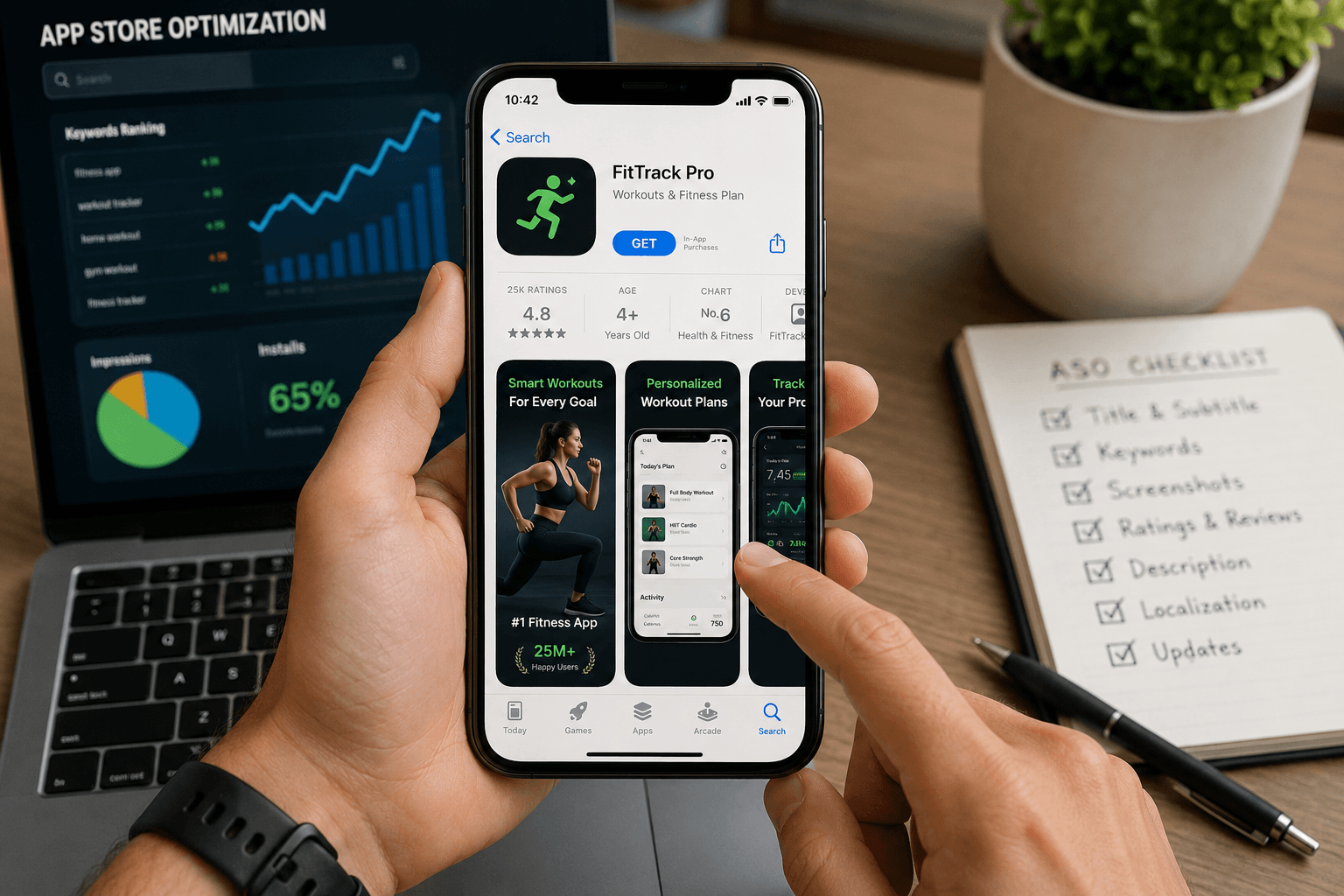
App Store Optimization (ASO) is the process of improving how easily your app is found and downloaded on the Apple App Store and Google Play. It covers what you write (title, subtitle, keywords, description), what you show (icon, screenshots, video), and what users do after they find you (ratings, retention, conversion rate).
In 2026, ASO is no longer a one-time metadata checklist. Apple now ranks apps using behavioral relevance and textual relevance as two named signals, screenshot caption text is indexed, and Google Play has moved its algorithm from rewarding raw install volume to rewarding retention. At the same time, around 65% of all app downloads still start with a search, so getting found is still the foundation everything else depends on.
This guide breaks ASO down into the parts you control directly — title, keywords, description, visuals — and the parts the algorithm measures from user behavior, so you can build a listing that ranks and converts in 2026.
Quick Answer: What Is ASO in 2026?
App Store Optimization (ASO) is the practice of optimizing an app’s title, keywords, description, visuals, and ratings to increase its visibility in app store search results and its conversion rate once a user lands on the listing. In 2026, ASO ranking depends on roughly 16 factors split between on-metadata fields you write yourself (title, subtitle, keyword field, description) and off-metadata signals the algorithm earns from user behavior (retention, conversion rate, ratings, engagement). Both Apple and Google now weight post-install behavior — what users do after downloading — as heavily as pre-install keyword matching.
Why ASO Still Matters in 2026
The numbers explain why ASO remains the cheapest, highest-leverage growth channel available to app publishers:
- The App Store holds around 2.19 million apps and Google Play over 2 million, as of early 2026.
- Apple’s own App Store Transparency Report shows 839 million new downloads per week against 1.9 billion redownloads — meaning users return to apps they already know more than twice as often as they discover new ones.
- Average CPI (cost per install) has climbed past $3.50 on iOS and $1.20 on Android, making organic discovery proportionally more valuable every year paid acquisition gets more expensive.
- Roughly 65% of app downloads are still driven by app store search, not by ads, referrals, or browse placements.
If your listing isn’t optimized for search and conversion, you are paying full price to compete for the remaining slice of discovery, and losing the free, compounding channel entirely.
How the App Store and Google Play Algorithms Actually Rank Apps in 2026
Apple and Google use different mechanics, but both now weigh two categories of signal: what you write into the listing, and what users do once they find it.
Apple App Store: Two Named Ranking Signals
In its March 2026 research paper on App Store search relevance, Apple confirmed it ranks apps using two signals:
- Behavioral relevance — taps on your listing, downloads, and post-install engagement and retention.
- Textual relevance — how closely your title, subtitle, and keyword field semantically match what someone actually searched.
Other confirmed 2026 changes on iOS:
- Screenshot caption text is now indexed. Apple began treating caption text on screenshots as a ranking input after an algorithm shift in June 2025, so generic captions are now a missed keyword opportunity, not just a design choice.
- Custom Product Pages (CPPs) rank organically. Since July 2025, you can link keywords to specific CPPs and have them surface in organic search results — not just paid traffic. The maximum number of CPPs also doubled from 35 to 70.
- More paid ads sit inside organic search results, starting with a phased rollout from March 2026. This compresses the organic results window, making every organic ranking position more competitive than it was a year earlier.
- The App Store description itself is not indexed for search — write it for human conversion, not for keywords.
Google Play: Retention Over Raw Downloads
Google Play indexes your full description for search, which gives you far more room to place keywords than iOS does. The major 2026 shifts:
- Guided Search now lets users type a goal (“track my expenses”) rather than a keyword, and the algorithm sorts results by category and intent rather than exact match.
- Engagement and retention are explicit ranking inputs, alongside Android Vitals technical health metrics. Apps that exceed Google’s crash rate, ANR, or excessive partial wake lock thresholds can be excluded from prominent discovery surfaces entirely.
- Metadata changes on Google Play don’t require a new build to go live, unlike most fields on iOS — so Play listings can be iterated faster.
App Store vs. Google Play: Where to Focus Your Keywords
Field | Apple App Store | Google Play |
Title | 30 characters, indexed, highest single ranking weight | 50 characters, indexed |
Subtitle / Short description | 30 characters, indexed | 80 characters, fully indexed |
Dedicated keyword field | 100 characters, indexed, not user-visible | None — no separate keyword field |
Full description | Not indexed for search | Fully indexed — keyword density matters here |
Screenshot captions | Indexed since June 2025 | Not indexed |
Update cadence for metadata | Requires a new build (except Promotional Text) | Can be changed live, no new build needed |
On-Page ASO: What You Write Yourself
These are the fields under your direct control. Apple and Google weigh them differently, but the underlying principle is the same: match the exact language your target users type, not internal product jargon.
1. App Title
Your title carries the single highest ranking weight in both stores. The structure that performs best in 2026:
- iOS (30 characters): Brand name + your single highest-priority keyword. Example: “Calzoro: Premium Leather Shoes”
- Android (50 characters): More room — brand name + 2–3 supporting keywords. Example: “LexaItaliano – Italian Leather Boots & Shoes for Men”
Avoid keyword-stuffing the title; both algorithms now penalize titles that read as unnatural strings of search terms rather than a name a human would say out loud.
2. Subtitle (iOS) / Short Description (Android)
This is your second-highest-weighted text field and the first line users read after the title.
- iOS subtitle (30 characters): A clear value proposition using a secondary keyword. Example: “Handcrafted Italian Footwear”
- Android short description (80 characters): Fully indexed — write it like a tight, benefit-led sentence, not a keyword dump.
3. Keyword Field (iOS Only)
Apple gives you 100 characters in a field users never see. Rules that still hold in 2026:
- No spaces after commas — every character counts.
- Never repeat words already used in your title or subtitle; the algorithm has already indexed them.
- Use singular forms; Apple’s matching handles most plurals automatically.
- Prioritize long-tail, lower-competition phrases over single high-volume head terms — in 2026, long-tail queries face less competition and convert at a higher rate.
4. Description
- iOS: Not indexed for search, so write purely for conversion — lead with benefits, use short paragraphs and bullet lists, and place your strongest selling point in the first three lines (only this much shows before “more”).
- Android: Fully indexed. Open with your primary keyword naturally in the first sentence, then weave in secondary keywords across the body without breaking readability.
5. Screenshots and Preview Video
User attention spans on a store listing are now measured in seconds, so your first screenshot does most of the conversion work.
- Lead with social proof (ratings, user count, “Featured by Apple/Google,” or a recognizable client logo) in the first screenshot — this alone can lift conversion by a meaningful margin.
- Use high-contrast caption text that’s legible at small sizes; check it on the smallest screen your audience uses.
- On iOS, captions are now OCR-indexed, so write them with the same keyword discipline as your title — describing real features, not stuffing terms.
- Add a preview video; portrait video specifically has been shown to lift watch time, completion rate, and conversion on Google Play.
6. Ratings and Reviews
A 4.6-star app converts visibly better than a 3.9-star app with otherwise identical metadata — the gap is one of the few quality signals users can see at a glance. Prompt for reviews at natural high-satisfaction moments, and reply publicly to reviews on Google Play, since replies are visible to every future visitor and build trust before they even open the listing.
Off-Page ASO: The Signals You Earn
These factors aren’t written into a form — they’re measured from what real users do, and in 2026 they carry as much ranking weight as your metadata.
- Retention — whether users keep opening your app after install. Both stores now treat this as a first-class ranking signal.
- Conversion rate — the percentage of people who see your listing and install. An app ranking third with a high conversion rate can out-earn an app ranking first with a weak one.
- Engagement depth — session length, feature usage, and return frequency, especially relevant to Google’s Collections and “You” tab recommendations.
- Technical health (Android Vitals) — crash rate, ANR rate, and excessive partial wake locks. From March 2026, apps that breach Google’s thresholds can be excluded from recommended and curated placements regardless of metadata quality.
- Update frequency — both platforms favor apps that ship regular, purposeful updates as a freshness and quality signal.
How to Get Your App Store Listing Cited in AI Overviews and AI Search
Search behavior is shifting from typed keywords to natural-language questions, and increasingly those questions get answered by Google’s AI Overviews, ChatGPT, or Perplexity before a user ever opens an app store. Around 58% of searches in active markets now surface an AI Overview at the top of the results. Optimizing your content — blog, FAQ pages, and comparison guides — to be cited in these answers is now part of ASO in the broadest sense.
What consistently earns AI Overview and featured snippet citations in 2026:
- Answer the question in the first 1–2 sentences of a section, before any preamble. AI systems extract self-contained chunks, so each section should make sense if read in isolation.
- Use question-format H2/H3 headings (“What is ASO?”, “How do you rank on the App Store?”) that mirror exactly how people phrase searches.
- Format for extraction: short definition paragraphs, numbered steps for processes, and comparison tables for anything with more than two variables.
- Keep content fresh. AI systems weight recency; a guide updated within the last 3–6 months with current statistics outperforms a stale one with otherwise identical quality.
- Show real expertise (E-E-A-T). Byline a named author, link to verifiable experience, and cite primary sources rather than other blog posts.
- Mark up content with schema (Article, FAQPage, HowTo) where it genuinely matches the content’s structure.
The practical takeaway: optimizing for a featured snippet and optimizing for an AI Overview citation are now the same exercise. Content that wins position zero is overwhelmingly the same content AI systems cite.
Common ASO Mistakes to Avoid in 2026
- Treating ASO as a launch-day checklist. Rankings shift continuously; apps need monthly review, not a one-time setup.
- Writing generic, decorative screenshot captions. On iOS, this is now a missed keyword opportunity.
- Ignoring technical health metrics. A great listing can’t overcome a high crash rate or ANR rate.
- Keyword-stuffing the title or keyword field. Both algorithms now favor natural-language relevance over exact-match density.
- Skipping localization. For apps with an optimized English listing but no localized stores, translation is typically a higher-return move than further English-only polishing.
- Assuming paid ads boost organic rank directly. They don’t — but the install velocity they generate can indirectly lift behavioral signals the organic algorithm rewards.
ASO Checklist: 2026 Quick Reference
☐ Title includes brand name + top keyword, within character limits for each store
☐ Subtitle / short description leads with a clear value proposition
☐ iOS keyword field uses all 100 characters with no repeats from title/subtitle
☐ Android description opens with the primary keyword in the first sentence
☐ First screenshot includes a social proof element
☐ Screenshot captions are keyword-aware, not generic
☐ A preview video (portrait, for Android) is live on the listing
☐ Review prompts are timed to high-satisfaction moments
☐ Android Vitals (crash rate, ANR, wake locks) are within Google’s thresholds
☐ Listing has been reviewed or updated within the last 30–60 days
☐ Supporting blog/FAQ content uses question-format headings and self-contained answers
Frequently Asked Questions
What the difference between ASO and SEO?
ASO optimizes for discovery inside app stores (Apple App Store, Google Play); SEO optimizes for discovery on web search engines like Google. They share the same underlying principle — matching content to real user search intent — but use different fields, different algorithms, and different ranking signals.
How long does it take to see ASO results?
Keyword ranking changes can appear within days of a metadata update. Sustainable ranking improvement typically takes 2–4 weeks, since both algorithms need time to evaluate engagement and retention signals before adjusting position.
Does paid advertising improve organic app store ranking?
Not directly. Apple and Google both state publicly that paid placements are separate from organic ranking. Indirectly, the install velocity a paid campaign generates can lift the same behavioral signals — downloads, engagement — that the organic algorithm rewards.
What matters more in 2026: keywords or ratings?
Neither works in isolation anymore. Keywords determine whether your app appears in relevant searches at all; ratings and retention determine whether the algorithm keeps showing it and whether users convert once they see it.
Is the App Store description indexed for search?
No. Apple’s app description is not used for search ranking — write it purely to convert visitors who already found you. Google Play’s full description, by contrast, is fully indexed.
Get best mobile app development services
Develop your business app
Conclusion
Need Help Optimizing Your App Store Listing?
Writing the metadata is one part of ASO — building an app that retains users, performs well technically, and earns the ratings that feed the algorithm is the other. Mr Mobile App Developer has delivered 550+ Android and iOS apps over 22+ years, handling everything from native Android development and iOS development to full App Store and Play Store submission, listing optimization, and post-launch maintenance and support.
If you’re planning a new app or want your current listing audited against the 2026 ranking factors above, schedule a free consultation or read more on building a complete app business plan for 2026.
Quality Service For You
We deliver unique and blended experiences to our customers across the globe. From idea to execution and launch, we do ALL.
Backend Development:
Table of Contents
Why Mobile Apps Fail After Launch: 15 Common Reasons and How to Prevent Them
How to Calculate ROI for Mobile App Development in 2026
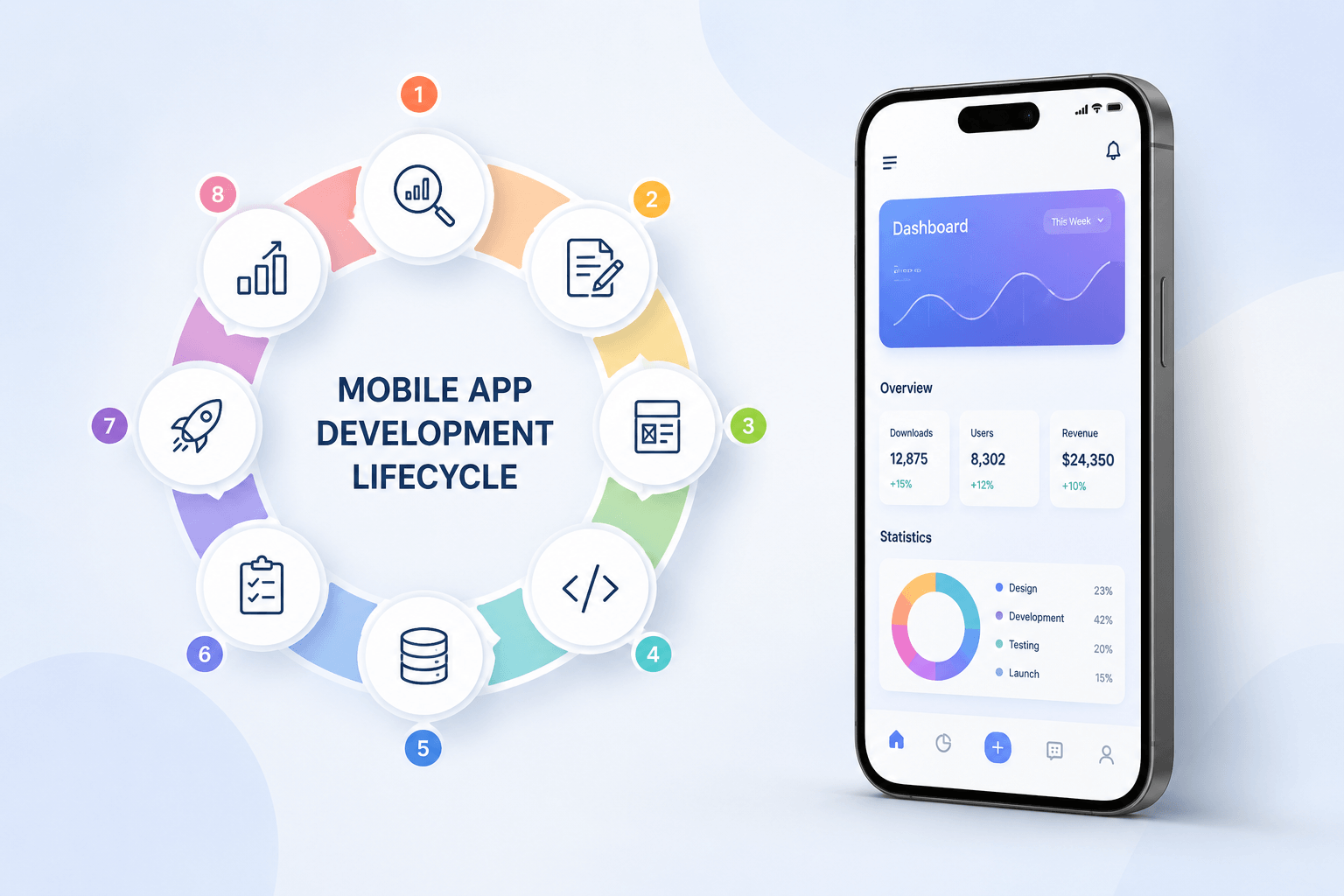
Mobile App Development Lifecycle: Complete 2026 Guide (8 Stages)
Book your consultation now
Related Post