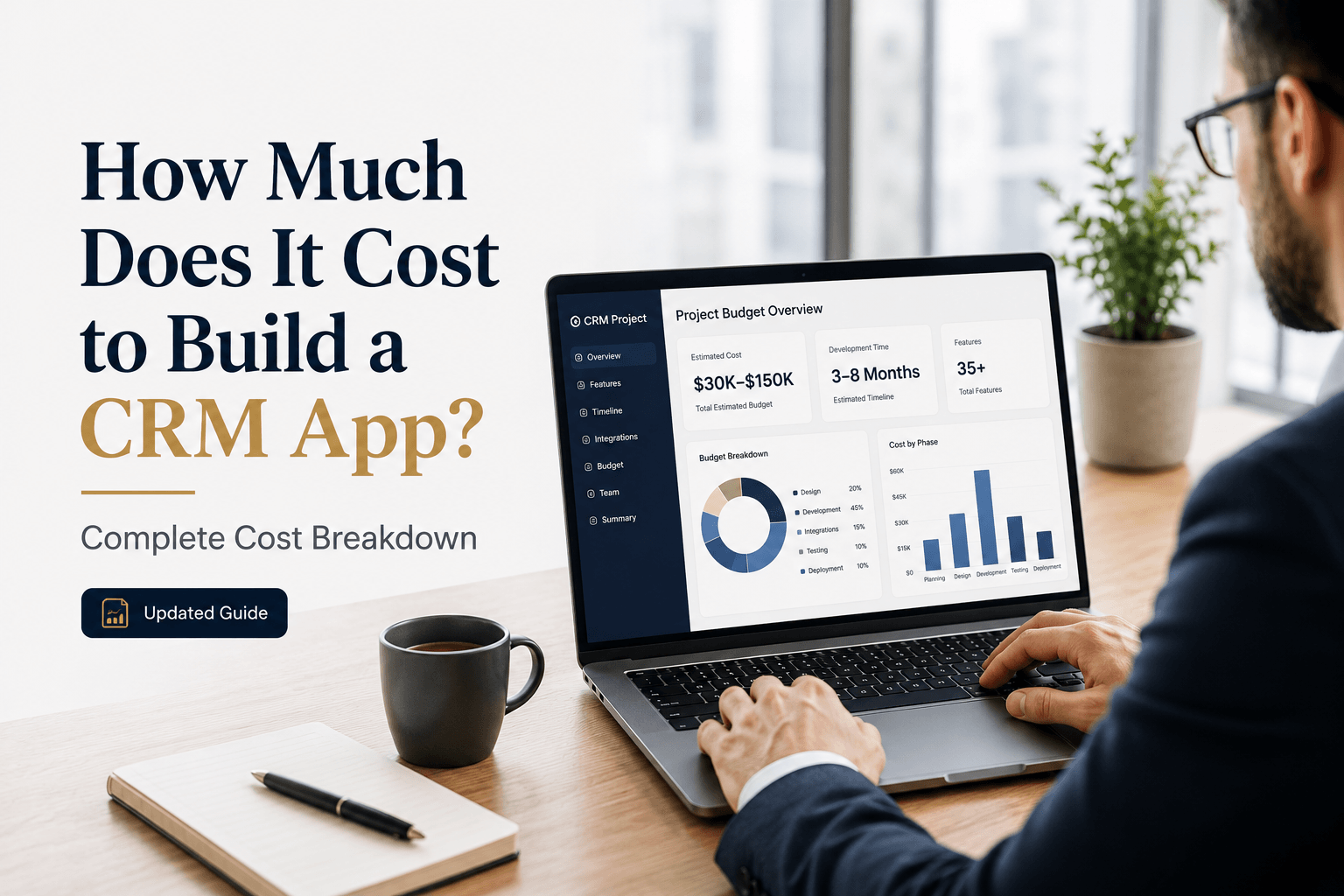
CRM App Development Cost in 2026 typically ranges from $25,000 to $150,000+ for a custom Customer Relationship Management (CRM) app, depending on feature complexity, platform choice (iOS, Android, or Web), third-party integrations, security requirements, scalability, and the development team’s location.
Here is a quick overview of custom CRM development costs and timelines:
CRM App Complexity | Average Cost Range | Estimated Timeline | Ideal For |
Basic / MVP CRM | $20,000 – $40,000 | 2 – 4 Months | Startups & small teams needing core contact & deal tracking |
Mid-Tier CRM | $40,000 – $80,000 | 4 – 6 Months | Growing businesses needing workflow automation & API sync |
Enterprise CRM | $80,000 – $180,000+ | 6 – 12+ Months | Large organizations requiring AI analytics, multi-branch, ERP sync |
Key Takeaway: While SaaS platforms like Salesforce or HubSpot cost $50 to $200 per user/month, a custom CRM eliminates recurring per-seat penalties and pays for itself within 18 to 28 months for teams over 20 users.
1. Custom CRM vs. SaaS: The 3-Year Cost Comparison
Many business leaders wonder: Is it cheaper to build a custom CRM or pay for off-the-shelf SaaS subscriptions?
For small teams (<8 users), SaaS solutions are usually more economical. However, as team size grows, subscription costs scale aggressively.
3-Year ROI Calculation (25-User Sales Team)
- Commercial SaaS CRM ($150/user/month):
- Year 1: $45,000
- Year 2: $45,000
- Year 3: $45,000
- 3-Year Total: $135,000 (and continues forever as team grows)
- Custom Built CRM ($60,000 initial build):
- Year 1: $60,000 build + $8,000 maintenance = $68,000
- Year 2: $8,000 maintenance + $10,000 upgrades = $18,000
- Year 3: $8,000 maintenance + $10,000 upgrades = $18,000
- 3-Year Total: $104,000 (Full data ownership, zero seat fees for 50+ reps)
2. Cost Breakdown by CRM Application Type
The scope and architecture of your custom CRM directly drive development costs:
Operational CRM ($30,000 – $75,000)
Focuses on streamlining day-to-day sales, marketing, and customer support activities.
- Key Features: Contact & account history, automated sales pipelines (Kanban view), email/SMS triggers, activity logs.
- Best For: Direct sales operations and customer desk workflows.
Analytical CRM ($45,000 – $110,000)
Analyzes user data, purchase behavior, and sales performance to reveal business insights.
- Key Features: Data warehousing, custom BI dashboards, trend reporting engines, predictive revenue forecasting.
- Best For: E-commerce, finance, and data-driven enterprises.
Collaborative CRM ($35,000 – $85,000)
Connects disparate internal teams (Sales, Technical Support, Billing, Management) in real time.
- Key Features: Shared client feeds, central document management, cross-department task assignments.
- Best For: Distributed or multi-branch organizations.
3. Key Feature Costs: MVP vs. Enterprise
Features account for 60% to 70% of your total development expenditure.
| Development Component | Share of Total Development Cost |
|---|
| MVP / Core Features | 35% |
| Advanced Features, APIs & Integrations | 25% |
| UI/UX Design | 15% |
| QA, Security & DevOps | 25% |
Essential Features (Phase 1 / MVP Scope)
- User Auth & Role-Based Security ($3,000 – $6,000): Multi-factor authentication (MFA) and admin/manager/rep role permissions.
- Contact & Deal Pipeline ($6,000 – $12,000): Visual drag-and-drop Kanban deal stages, custom contact fields, and interaction history.
- Task & Calendar Management ($4,000 – $8,000): Automated meeting scheduling, follow-up reminders, and Google/Outlook sync.
- Basic Reporting & Filtering ($4,000 – $7,000): Revenue totals, rep leaderboards, and date filters.
Advanced Features (Phase 2 Scale)
- AI-Powered Lead Scoring & Insights ($12,000 – $30,000): Predictive machine learning algorithms prioritizing high-converting prospects.
- Third-Party API Sync ($5,000 – $20,000 per integration): Connecting with ERPs, Stripe, QuickBooks, Twilio, or WhatsApp Business API.
- Workflow Automation Engine ($8,000 – $18,000): Custom trigger-action workflow builder for email drip series and automatic deal escalation.
- Offline Mobile Access & Auto-Sync ($7,000 – $15,000): Allowing field sales reps to log data without mobile coverage.
To ensure your mobile CRM runs smoothly across both Android and iOS without doubling your budget, partner with specialized mobile app development experts who leverage cross-platform frameworks like React Native or Flutter.
4. Developer Hourly Rates by Region
Where you build your application has a dramatic impact on total costs:
Developer Location | Average Hourly Rate | Mid-Level CRM Total Budget |
North America (Agency) | $120 – $220 / hr | $80,000 – $160,000 |
Western Europe (Agency) | $80 – $140 / hr | $55,000 – $110,000 |
Eastern Europe / Asia (Agency) | $35 – $70 / hr | $30,000 – $65,000 |
Global Freelancers | $25 – $60 / hr | $20,000 – $45,000 (Requires high technical oversight) |
5. Ongoing & Hidden Maintenance Costs
Your initial build price covers roughly 70% of first-year total costs. Budget for the following ongoing items:
- Annual Maintenance & Support (15% – 20% / year): Security patches, OS updates (iOS/Android releases), and performance fixes (~$5,000 – $15,000/year).
- Cloud Infrastructure (AWS / GCP / Azure): Managed database instances and cloud server hosting (~$100 – $600/month).
- Third-Party API Services: Email services (SendGrid), SMS/WhatsApp APIs (Twilio), or AI endpoints (~$50 – $400/month).
- Data Migration: Cleaning and migrating old data from legacy Excel sheets or SaaS platforms (~$2,000 – $10,000 one-time).
6. How to Cut CRM Development Costs by 30–40%
- Launch a Lean MVP First: Build only the 8 to 10 features your sales reps use daily. Validate with real workflows before adding AI or custom automation.
- Choose Cross-Platform Frameworks: Utilizing Flutter or React Native allows a single codebase to serve both iOS and Android, saving up to 35% in initial code production.
- Use Verified Pre-Built Modules: Implement tested third-party SDKs for authentication, charting libraries, and notification queues rather than building from scratch.
Frequently Asked Questions (AI Overview & SERP Snippet Ready)
How much does it cost to build a custom CRM app in 2026?
A custom CRM app costs between $25,000 and $150,000+. A simple MVP costs $20,000–$40,000, a mid-tier solution costs $40,000–$80,000, and an enterprise AI-driven platform costs $80,000–$180,000+.
How long does it take to develop a custom CRM?
A basic CRM MVP takes 2 to 4 months, mid-level CRMs take 4 to 6 months, and enterprise-grade systems take 6 to 12+ months from initial discovery to deployment.
Is custom CRM development cheaper than Salesforce or HubSpot?
Yes, for businesses with more than 15–20 active users. While SaaS platforms charge recurring monthly per-user fees ($50–$200/user/month), custom CRM development involves an upfront investment with zero per-user licensing fees, delivering a positive ROI within 2 years.
Ready to Build Your Custom CRM Solution?
Avoid bloated subscription fees and build software tailored to your exact business workflows. Explore custom mobile and web application development at Mr Mobile App Developer.